Cut Time Explained: Count 2/2 Without Rushing
Cut time, or 2/2, usually has two half-note beats per measure. It can contain the same written note values as 4/4 while grouping them into two larger beats.
What the cut-time symbol and 2/2 mean
The cut-time symbol is a C crossed by a vertical line. Its beat unit is normally the half note. Counting two broad beats can make a brisk passage feel less crowded than treating every quarter as a separate main beat. The score’s tempo instruction determines the actual speed.
Compare half note = 60 with quarter note = 60
At half note = 60 in 2/2, each half-note beat lasts one second and each written quarter lasts half a second. At quarter note = 60 in 4/4, a quarter lasts one second. The same numerical BPM is therefore insufficient unless the associated note value is stated.
Try it in practice
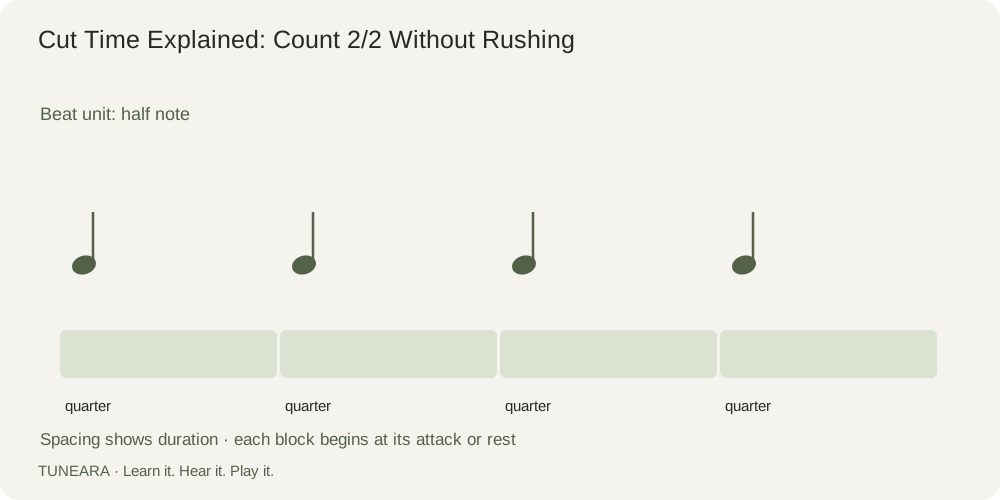
Count “1 and 2 and” with each number representing a half note and each “and” a quarter. Play four quarter notes in the measure, then two half notes, keeping the same two-beat frame. Compare with four-beat counting to hear the difference in grouping, not just in number of spoken syllables.
Avoid a common mistake
Do not automatically double the performed tempo when you see 2/2. A change of meter and a change of speed are different instructions. Check any metric-modulation marking, composer indication, or rehearsal agreement that tells you how the old and new beat units relate.
Read the visual example
What to learn next
Connect this lesson to BPM and beat length, then try time signatures and beat grouping.
References and further learning

Get Tuneara
Your next practice
starts here.
A free tuner and metronome for iPhone and Android.