How to Find the Beat in a Piece of Music
To find a beat, listen for a regular pulse that fits the musical phrase, then tap it through several measures. Do not assume every played note is a beat.
Listen for a pulse beneath the notes
A bass line, drum part, repeated chord, or melodic accent can suggest a pulse. The beat may continue through silence and sustained notes. Listen to a whole phrase before choosing a tapping speed; a short burst of fast notes can make the underlying pulse seem quicker than it is.
Compare quarter-note beats with eighth-note attacks
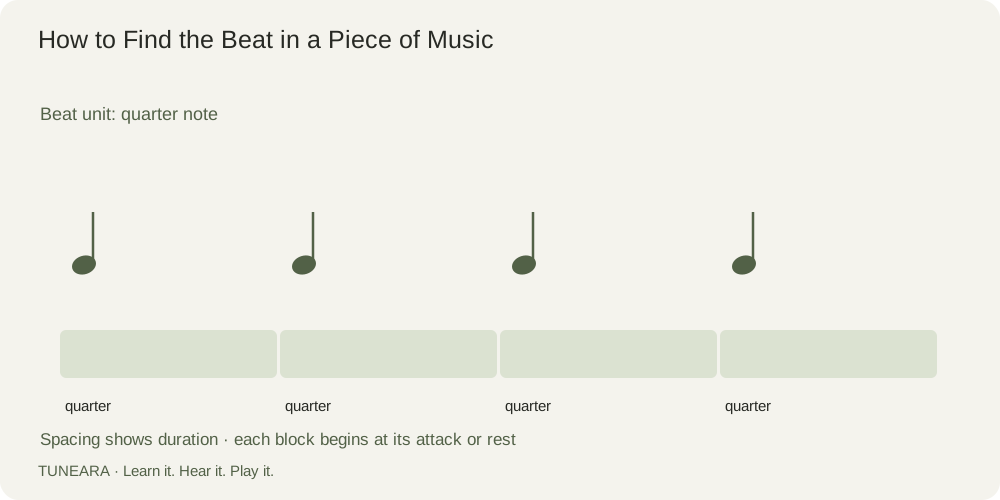
If a passage contains eight evenly spaced eighth notes in 4/4, the main pulse can be four quarter-note beats. Tapping every note follows the subdivision instead. Both can fit the time spacing, but the meter and phrasing help identify the intended beat level. Some music supports more than one plausible level.
Try it in practice
Choose a short recording with a clear rhythm section. Listen once without moving, then tap a comfortable pulse for eight measures. Stop tapping for one measure while keeping the pulse internally, and rejoin. If your return is uncertain, listen again for the repeating bass or drum pattern before using a metronome.
Avoid a common mistake
Do not force a rigid click onto a performance that intentionally changes tempo. Rubato, pickups, and sparse textures can hide the main beat. A correct subdivision can also feel like a different tempo level, so check the phrase grouping rather than treating a single tapping rate as proof.
Read the visual example
What to learn next
Connect this lesson to BPM and beat length, then try time signatures and beat grouping.
References and further learning

Get Tuneara
Your next practice
starts here.
A free tuner and metronome for iPhone and Android.