Pulse vs. Rhythm: Keep the Beat Under the Pattern
Pulse is the recurring time reference; rhythm is the pattern of sounds and silences placed around it. You can change the rhythm while keeping the same pulse.
What is the difference between pulse and rhythm?
The pulse acts like evenly spaced landmarks. Rhythm decides which landmarks or subdivisions receive an attack, how long each sound lasts, and where silence appears. A melody can sustain across several beats while the pulse continues. Listening for both layers makes complicated patterns easier to organize.
Compare three rhythms over one 4/4 pulse
At a quarter-note pulse, four quarter notes, eight eighth notes, and a half note followed by two quarters can all occupy one 4/4 measure. Their rhythms differ, but the four pulse positions remain fixed. A change from quarters to eighths does not automatically mean the tempo doubled.
Try it in practice
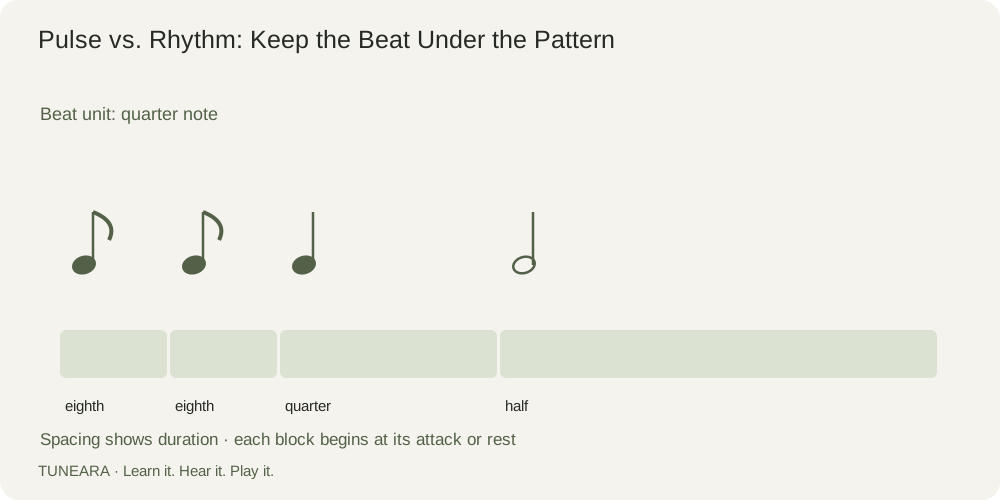
Tap four steady beats with one hand. Clap a rhythm of two eighths, a quarter, a half note with the other hand or your voice. Keep the tapping unchanged as the rhythm speeds up and slows down above it. If coordination is difficult, speak the rhythm while walking the pulse first.
Avoid a common mistake
Do not move your pulse to follow every attack. That turns the reference into another copy of the rhythm. Conversely, do not flatten an expressive phrase into identical short notes merely to show the beat. A stable underlying reference can support different articulations, durations, and accent patterns.
Read the visual example
What to learn next
Connect this lesson to BPM and beat length, then try time signatures and beat grouping.
References and further learning

Get Tuneara
Your next practice
starts here.
A free tuner and metronome for iPhone and Android.