Straight vs. Swing Eighth Notes: Compare the Feel
Straight eighths divide the beat evenly. Swing commonly makes the first eighth longer and the second shorter, with a ratio that varies by style, tempo, and performer.
How straight and swing eighth notes divide the beat
Notation can use the same eighth-note pair for either feel, so check the style marking and listen to a reference performance. A triplet-based long-short interpretation is a useful introduction to some swing contexts, but it is not a universal measured ratio. Ensemble agreement matters more than imposing one formula.
Compare a midpoint attack with a triplet approximation
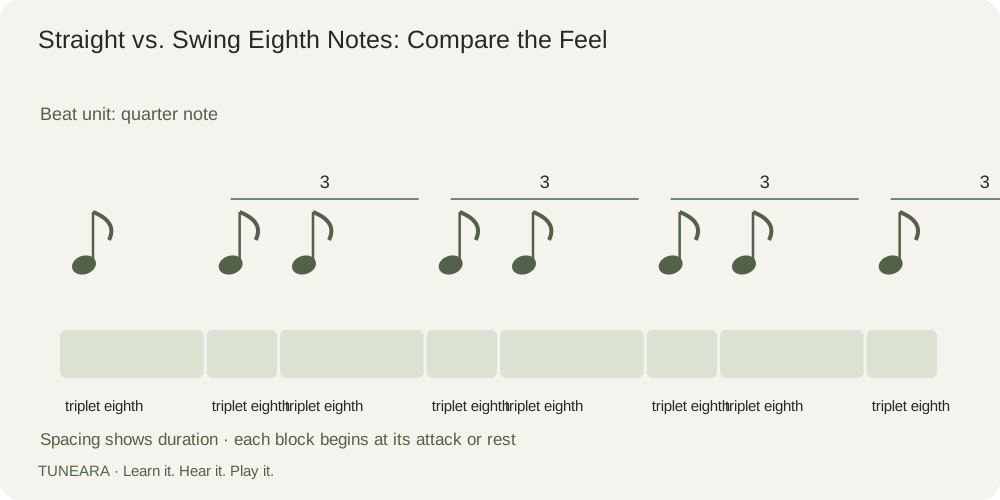
At a steady quarter-note pulse, straight attacks land at the beat and its midpoint. A basic triplet approximation places the second attack on the final triplet subdivision. The next numbered beat still arrives on time. Accents and articulation also influence swing, so timing alone does not create the complete style.
Try it in practice
Clap four beats of straight eighths while counting “1 and.” Switch to a gentle long-short feel for four beats, then return to straight. Record the exercise and listen for whether the main beat speeds up during the switch. Copy a short phrase from a chosen performance only after identifying its style and tempo.
Avoid a common mistake
Do not label every uneven pair as swing; dotted rhythms and expressive timing can create other relationships. Avoid forcing a rigid triplet feel onto all jazz or blues performances. Use the notation, recording, and ensemble’s shared interpretation together when choosing the subdivision.
Read the visual example
What to learn next
Connect this lesson to BPM and beat length, then try time signatures and beat grouping.
References and further learning

Get Tuneara
Your next practice
starts here.
A free tuner and metronome for iPhone and Android.