How to Transcribe a Simple Melody on Your Instrument
← Back to Ear training exercises
To transcribe a melody, isolate a short phrase, find its tonal center and starting note, then map its contour, rhythm, and pitches before checking the result.
How to choose a manageable phrase to transcribe
Begin with one clearly audible melody rather than a dense arrangement. Repeat a small phrase at a manageable speed if your playback tool supports it. The task is to recover what is heard, so distinguish a confident observation from a guess. Keep original recordings and your own proposed notes separate until you compare them.
Map a rising melody with scale degrees first
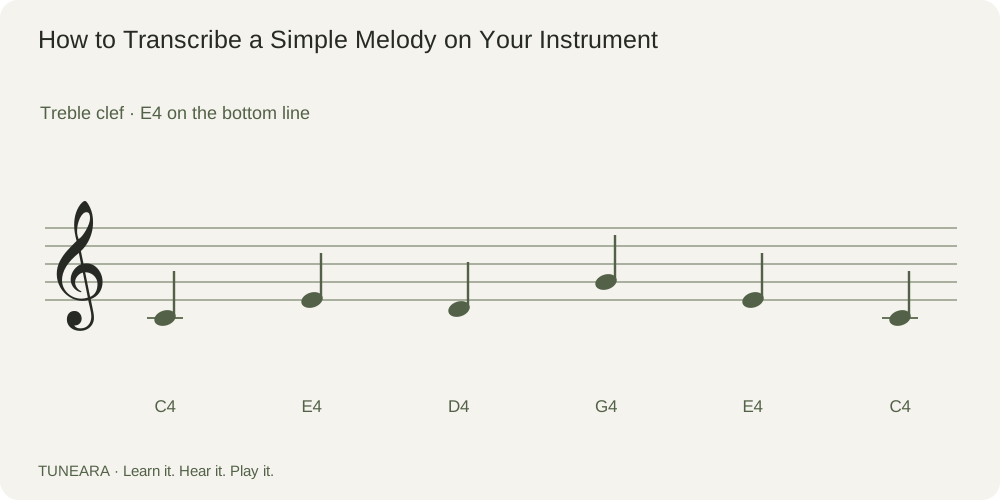
A phrase that rises by steps and returns to the tonic may be easier to record as degrees before absolute notes. Once the key is established, translate the degrees. If a recording lies between standard pitch references, acknowledge that possibility rather than repeatedly assuming your correctly tuned instrument is wrong.
You can first learn the phrase by playing it back; writing a score is optional. If you want to turn the result into notation, follow the melodic dictation exercise and check note lengths as well as pitches.
Try it in practice
Choose a phrase lasting one or two measures. Sing it back, find the first note, and test only the next small segment. Write the rhythm separately if pitch hunting disrupts your pulse. Play your completed version along with the reference, listening especially to phrase endings and sustained notes.
Avoid a common mistake
Do not assume the melody starts on the tonic or that every note belongs to the key signature. Chromatic passing tones and pickups are common. Also avoid copying the first plausible fingering as though it proves the note sequence; verify the pitches and rhythm before deciding the most comfortable position.
Read the visual example
What to learn next
Connect this lesson to Musical Intervals: Count Letters and Semitones, then try How to Match Pitch: Listen, Sing, and Check.
References and further learning

Get Tuneara
Your next practice
starts here.
A free tuner and metronome for iPhone and Android.