Melodic Dictation: Write a Short Tune by Ear
← Back to Ear training exercises
Melodic dictation turns a heard phrase into notes. Establish the tonic and meter, sketch the contour, then solve pitch and rhythm in small passes.
How to turn a heard melody into written notes
Start with a short phrase using a limited range and familiar scale. You do not need to identify every detail on the first hearing. Separate broad structure from exact notation: number of measures, high and low points, repeated notes, and phrase ending. These observations give later pitch decisions a framework.
Sketch contour before choosing exact pitches
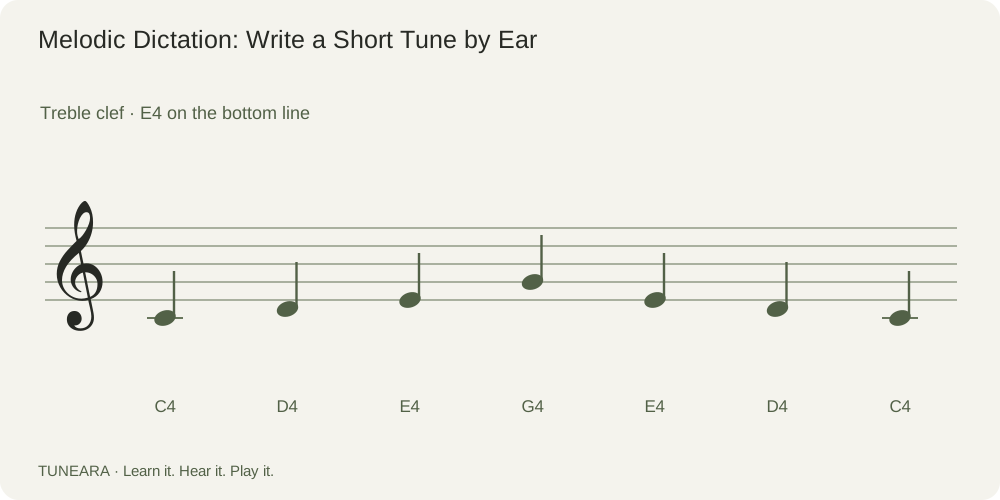
For a C-major phrase C–D–E–G–E–D–C, the contour rises, leaps upward, then falls home. Scale degrees 1–2–3–5–3–2–1 can be easier to record than immediate staff placement. Add durations after you can keep the phrase’s pulse, then translate degrees into the chosen key.
Melodic dictation focuses on writing what you hear in musical notation. If your goal is to learn a recorded tune directly on your instrument, use the melody transcription routine, which adds phrase looping, pitch matching, and a play-along check.
Try it in practice
Have a partner play a two-measure melody using C through G, or record an original example and revisit it later. Listen once for contour, once for rhythm, and once for exact pitches. Sing your written version and compare it with the reference. Correct a specific mismatch rather than erasing the whole answer automatically.
Avoid a common mistake
Do not begin with a dense commercial recording and assume every heard layer belongs to the melody. Use one clear voice first. Also avoid random trial-and-error at the instrument before forming a listening hypothesis; it can replace memory of the phrase with unrelated pitches.
Read the visual example
What to learn next
Connect this lesson to Musical Intervals: Count Letters and Semitones, then try How to Match Pitch: Listen, Sing, and Check.
References and further learning

Get Tuneara
Your next practice
starts here.
A free tuner and metronome for iPhone and Android.