Tuning a Guitar with Harmonics: Method and Limitations
← Back to Guitar tuning and fretboard notes
Harmonics can help compare strings, but common fifth-fret and seventh-fret harmonic matches favor pure intervals that differ slightly from equal temperament. Use them as listening checks and verify open-string targets afterward.
Produce a clear natural harmonic
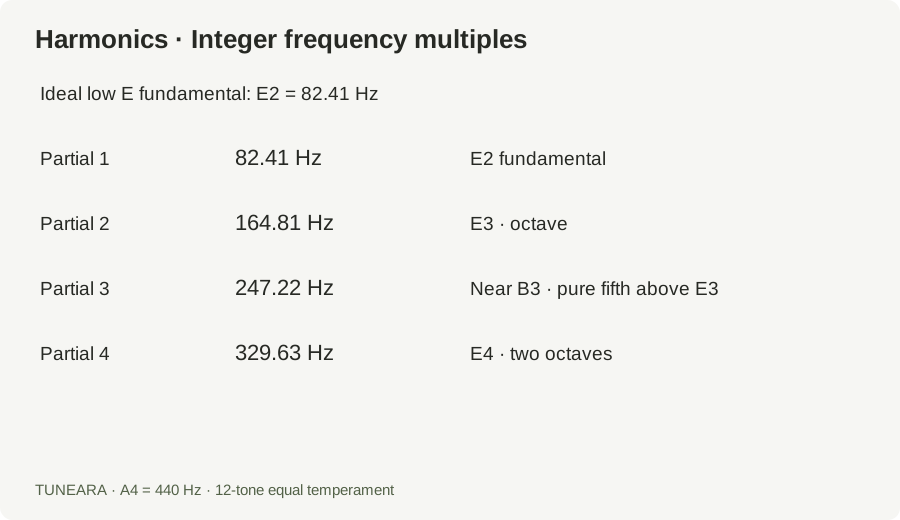
Touch a string lightly over the twelfth-fret wire, pluck it, and release the touching finger. Do not press the string down. The resulting harmonic is approximately twice the open-string frequency, one octave higher. The touch suppresses vibration patterns that do not have a node at that position.
Near fret 7, the commonly used harmonic is the third partial, about three times the fundamental. At fret 5, it is the fourth partial, about four times the fundamental. The seventh-fret wire is only an approximation to the exact one-third-length node, so a small touch-position adjustment may help the note speak.
Compare the familiar harmonic pairs
The fifth-fret harmonic on low E is approximately E4. The seventh-fret harmonic on A is near that pitch. Similar comparisons work for A–D, D–G, and B–E. They do not give the same simple relationship for the G–B pair, which is a major third rather than a fourth.
For B, you can compare open B3 with the low E string's seventh-fret harmonic, approximately B3. For the top E, compare it with the low E string's fifth-fret harmonic, approximately E4. These are approximate checks; a chromatic tuner remains useful for establishing the target frequencies.
Understand the equal-temperament difference
An exact fourth-partial-to-third-partial match sets neighboring fundamentals in a ratio of 4:3. An equal-tempered fourth is 2 raised to the power 5/12. The pure fourth is about 1.96 cents wider. Repeating pure matches can spread small differences across the strings.
This is not evidence that one tuner is broken. A fretted guitar is designed around approximately equal-tempered pitch spacing, while natural harmonics come from string vibration. Real strings also have some inharmonicity, so partial frequencies are not perfectly ideal.
Use harmonics for a focused check
Tune the open strings first. Then listen to a twelfth-fret harmonic and compare it with the same string fretted at fret 12. A persistent fretted mismatch suggests intonation, technique, or string-condition questions; the harmonic alone cannot diagnose the cause.
Try just one E–A comparison and inspect the tuner afterward. Learning to hear the small difference is more useful than forcing every harmonic pair to beat perfectly slowly and then wondering why chords changed. For a more direct fretted comparison method, use tuning by ear.
References and further learning

Get Tuneara
Your next practice
starts here.
A free tuner and metronome for iPhone and Android.