How to Tune a Guitar by Ear Using the Fifth-Fret Method
← Back to Guitar tuning and fretboard notes
To tune a standard guitar by ear, establish one accurate reference string, then match neighboring open strings to fretted notes. Use fret 5 for most pairs and fret 4 on the G string when tuning B.
Get one trustworthy reference
Relative tuning makes strings agree with one another. It does not establish concert pitch unless one note is already reliable. Set the low E to E2 with a tuner or another known reference. If starting from an A4 reference such as a tuning fork, remember that open string 5 is A2, two octaves lower; its twelfth fret is A3.
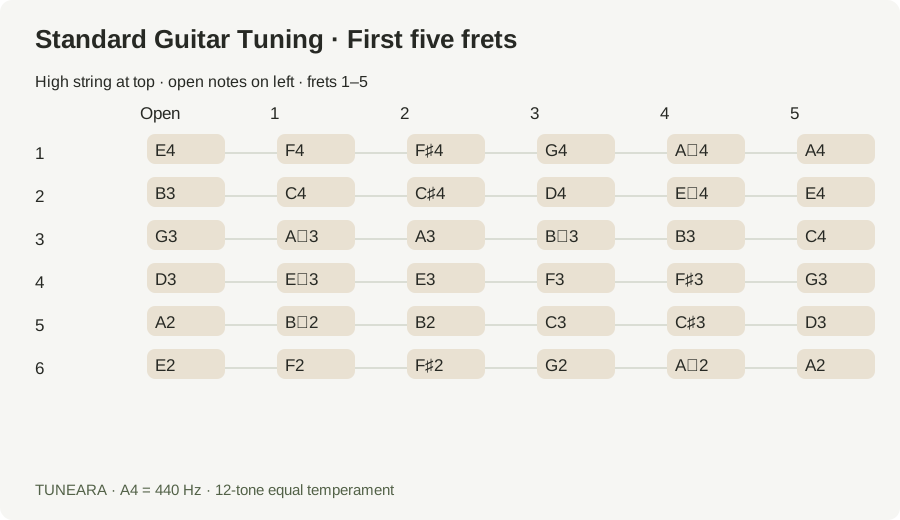
Use the standard target chart to keep octave relationships clear. Compare pitches at a comfortable volume. Let both notes ring if possible, but avoid accidentally bending the fretted string sideways.
Match the five string pairs
- Fret low E at fret 5 to produce A2; match open string 5 to it.
- Fret A at fret 5 to produce D3; match open string 4.
- Fret D at fret 5 to produce G3; match open string 3.
- Fret G at fret 4 to produce B3; match open string 2.
- Fret B at fret 5 to produce E4; match open string 1.
The fourth-fret exception reflects standard tuning's major third between G and B. Using fret 5 there would give C4 and put the second string a semitone high. This method also needs a new target map if you change to DADGAD or another alternate tuning.
Listen for beats, then check direction
Two sustained notes close in frequency can create a pulsing or beating sound. As their frequencies approach one another, the pulse slows. A pulse alone does not tell you which note is higher. Sing the notes, alternate them, or make one very small adjustment and listen for whether the pulse speeds up or slows down.
At low guitar pitches, overtones and different tone colors can complicate that perception. Start with a single pair instead of rushing through all six strings. A quiet room and light fretting pressure make the exercise easier to judge.
Prevent errors from accumulating
Each comparison depends on the reference before it. A small error on string 5 can be copied into strings 4, 3, 2, and 1. At the end, check the outside E strings as a two-octave pair, then verify all open strings with a tuner while you are learning.
Fretting stretches strings, and excessive pressure can make your comparison note sharp. If several upper strings end up sharp, repeat the exercise more lightly before blaming your hearing. Persistent differences may involve intonation. Ear tuning is a useful musical skill, but it works best with cross-checks and a reliable starting pitch.
References and further learning

Get Tuneara
Your next practice
starts here.
A free tuner and metronome for iPhone and Android.

