How to Tune a Guitar with a Tuner: A Beginner Routine
← Back to Guitar tuning and fretboard notes
To tune a guitar, choose the correct open-string targets, play one string at a time, and adjust its tuning key until the intended note is centered. Confirm the note and octave before using the sharp or flat indicator.
Start with the target, not the meter
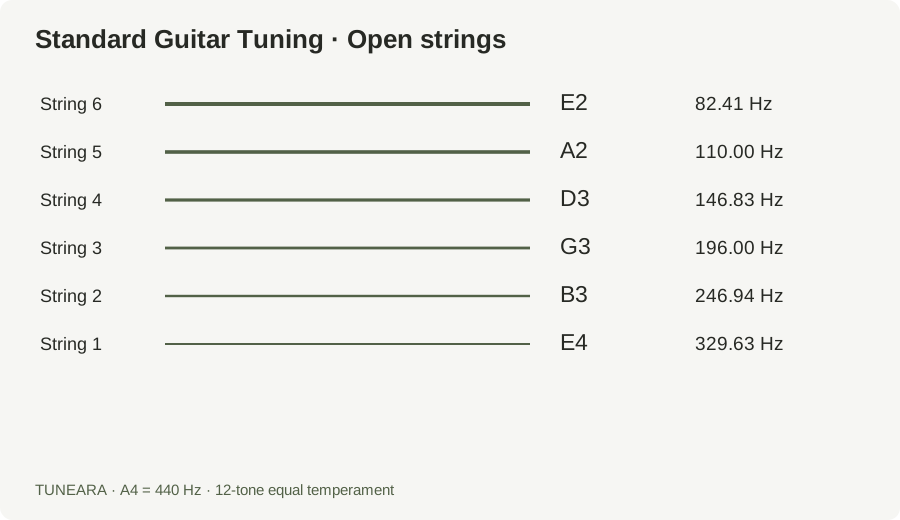
For standard tuning, use E2–A2–D3–G3–B3–E4 from string 6 to string 1. Keep the standard guitar chart beside you. A centered reading means little if the tuner is centered on the wrong note. An E string accidentally tuned to E-flat is still a semitone low.
Sit with the guitar in playing position. Support it comfortably, reduce background noise, and identify which key moves the string you are about to play. Headstocks differ, so “clockwise always raises pitch” is not a dependable instruction.
Follow one repeatable sequence
- Mute the other strings and pluck the sixth string at a moderate volume.
- Let the initial attack settle, then read the note name and octave.
- If the note is below the intended target, raise it gradually. If above, lower it gradually.
- Make a small change, stop turning, and pluck again before judging the result.
- Repeat for strings 5 through 1, then check the full set again.
Approaching the final pitch from below can help take up slack in a normal tuning mechanism. If you overshoot, lower a little below the target and return gradually. This does not repair a slipping string or a binding nut; those need their own diagnosis.
Handle an uncertain reading
If the display changes rapidly, damp nearby strings and pick again more gently. A strong harmonic can give the right letter in the wrong octave. Compare the sound with a known reference before increasing tension. If you cannot identify the intended octave, stop adjusting and get help from a teacher.
A microphone tuner needs a clear acoustic signal. An electric guitar in a loud room may work more conveniently with a compatible direct-input or clip-on tuner. Tuneara's mobile tuner offers instrument and chromatic modes; the website itself is not an online microphone tuner.
Finish by listening and playing
Play an open E minor or another familiar chord using light pressure. Check one or two octaves on the neck. If open strings agree with the tuner but fretted notes remain consistently sharp, review intonation and fretting pressure instead of repeatedly detuning the open strings.
Retune after a major tuning change, a string replacement, or a temperature change that has moved the instrument's pitch. A second quick pass is usually more informative than endlessly trying to freeze a moving display at one exact number. For independent listening practice, learn tuning by ear after you can confidently identify each target.
References and further learning

Get Tuneara
Your next practice
starts here.
A free tuner and metronome for iPhone and Android.