Standard Guitar Tuning: EADGBE Notes and String Order
← Back to Guitar tuning and fretboard notes
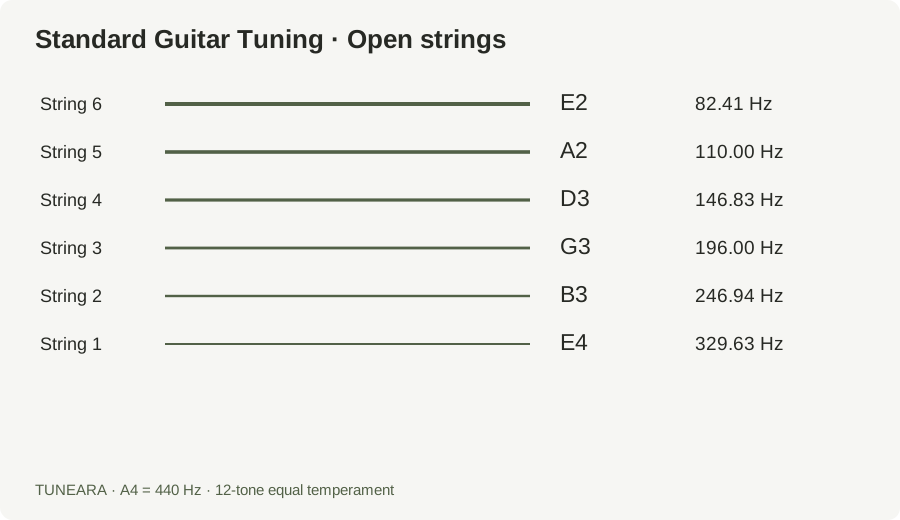
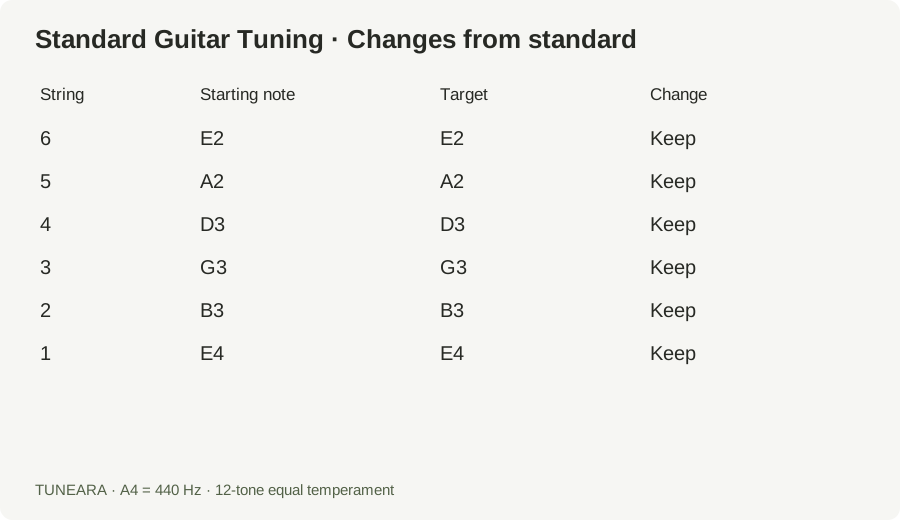
Standard tuning gives you E2–A2–D3–G3–B3–E4, from string 6 to string 1. Learn the string numbers first, then match each open string to its target pitch.
Open-string notes and frequencies
All notes below are sounding pitches in scientific pitch notation, not the octave-transposed pitches of conventional guitar staff notation. Frequencies use A4 = 440 Hz and twelve-tone equal temperament. Strings are listed from lowest pitch to highest.
| String | Target | Frequency |
|---|---|---|
| 6 | E2 | 82.41 Hz |
| 5 | A2 | 110.00 Hz |
| 4 | D3 | 146.83 Hz |
| 3 | G3 | 196.00 Hz |
| 2 | B3 | 246.94 Hz |
| 1 | E4 | 329.63 Hz |
Read the strings in the right direction
String 1 is the thin high E; string 6 is the thick low E. “Low to high” describes pitch, not where the string appears in a photograph. When you hold a right-handed guitar in playing position, the low E is usually closest to your face. The same string numbers apply to a left-handed guitar.
The two E strings share a letter but are two octaves apart. E2 is about 82.41 Hz and E4 is about 329.63 Hz. If a low string registers E3, it may be a harmonic reading. Do not tighten it an octave to satisfy the display.
Why the B string is different
Most neighboring strings are five semitones apart. G3 to B3 is four semitones, a major third. This is why a fingering shape often changes when it crosses the G–B boundary. On standard tuning, the fifth fret of each lower string matches the next open string except G: use its fourth fret to match open B.
Try open A2, then the fifth fret of low E. They should have the same pitch. Repeat D3 against the fifth fret of A. These are listening checks after tuning, not a replacement for a reliable starting reference.
Tune and check a musical example
Use the step-by-step tuning routine to bring each string to pitch. Then play a familiar E minor chord with light pressure. If the open strings read correctly but the chord sounds sharp, reduce your grip and check intonation before retuning everything to one chord.
Standard chord diagrams assume these open notes unless another tuning is stated. A chart written for Drop D changes the sixth-string notes; it does not change the names of the other five strings. Keep a tuning label with any exercise you save.
Learn the first five frets
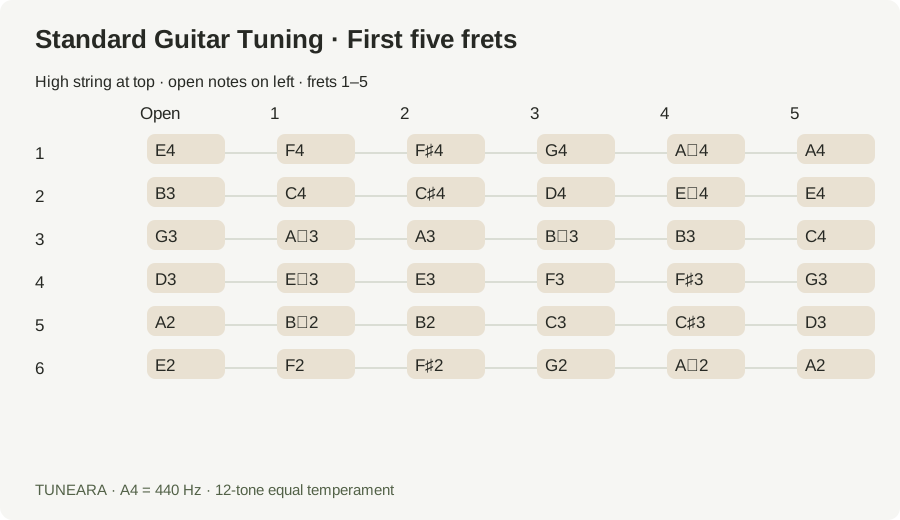
Use the note map below to connect an open string to the notes above it. Each fret adds one semitone. E goes to F immediately; B goes to C immediately. There is no extra sharp note between those pairs in the usual twelve-note system.
Choose one string per practice session. Say the open note, play up to fret 5, then return slowly. Finish by finding the same pitch on a neighboring string. This makes the chart useful for tuning by ear and for reading melodies, rather than just memorizing a letter sequence.
Compare the tuning and explore the fretboard
References and further learning

Get Tuneara
Your next practice
starts here.
A free tuner and metronome for iPhone and Android.