Guitar String Gauge and Tuning: Understanding Tension
← Back to Guitar tuning and fretboard notes
String gauge affects tuning feel because string mass, vibrating length, and target frequency together determine tension. Lower tunings often benefit from more mass, but the right set depends on your guitar, technique, and setup.
Start with the physical relationship
For an ideal flexible string, frequency equals 1 divided by twice the vibrating length, multiplied by the square root of tension divided by mass per unit length. Rearranged, tension is mass per unit length times the square of twice length times frequency.
That means lowering frequency with the same string and scale length reduces tension by the square of the frequency ratio. A whole-step drop gives about 79% of the starting tension; a four-semitone drop gives about 63%. These are useful estimates, not direct measurements of your guitar.
Understand why diameter is not enough
For a plain string of the same material, greater diameter means greater mass per length. Wound strings add core shape, core diameter, wrap material, and construction choices. Two strings with the same nominal gauge can therefore have different tension and feel.
Use a manufacturer's tension information for the specific set when available. Avoid applying a simple plain-wire diameter calculation to every wound string. Feel also depends on action, scale length, break angles, and how you bend or pick.
Match the choice to the tuning change
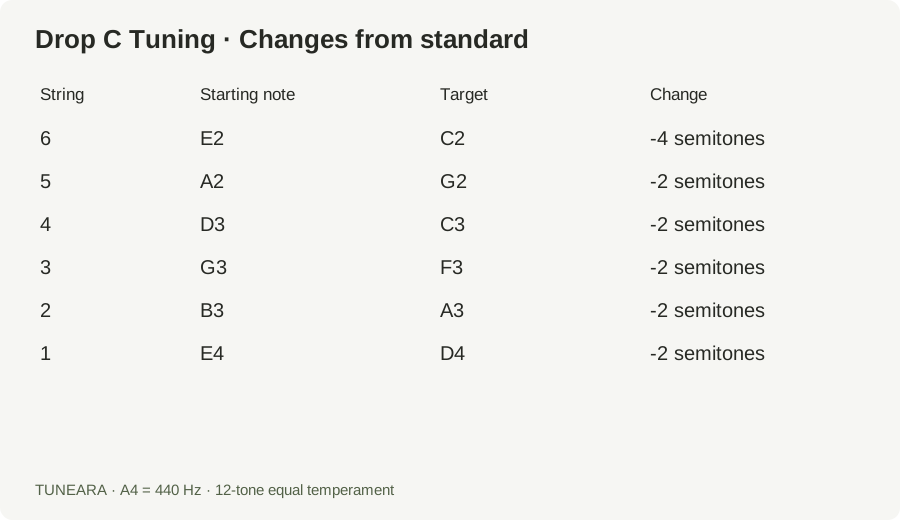
A standard set lowered to Drop D changes tension mainly on string 6. Lowering every string to D standard changes the whole set. Drop C additionally lowers the sixth string, which can make the bass response especially soft.
This suggests evaluating each string's role instead of assuming one uniform gauge increase solves everything. A player using light picking may prefer a different response from someone using a heavy attack. There is no universally correct “Drop C gauge.”
Include scale length and setup
At the same pitch and string mass per length, a longer vibrating length requires higher tension. This helps explain why identical strings can feel different on guitars with different scale lengths. It also means advice for one instrument may not transfer directly to another.
A thicker string can bind in a narrow nut slot, and a different set can alter neck relief, bridge balance, and intonation. Do not force a string into an unsuitable slot or assume tuning keys are the only adjustment needed.
Evaluate one change at a time
Choose a target tuning, install a suitable set using the maker's instructions, and test your normal playing. Listen for buzz, a sharp initial attack, and pitch movement under fretting pressure. Record the set and tuning before deciding what to change next.
If the guitar needs repeated large tuning changes, a dedicated setup for the most-used tuning may be more convenient. A technician can help balance string choice and hardware adjustments. The goal is reliable musical response, not maximizing tension or following a gauge number without context.
References and further learning

Get Tuneara
Your next practice
starts here.
A free tuner and metronome for iPhone and Android.

