D Standard Tuning: Whole-Step-Down Notes and Chords
← Back to Guitar tuning and fretboard notes
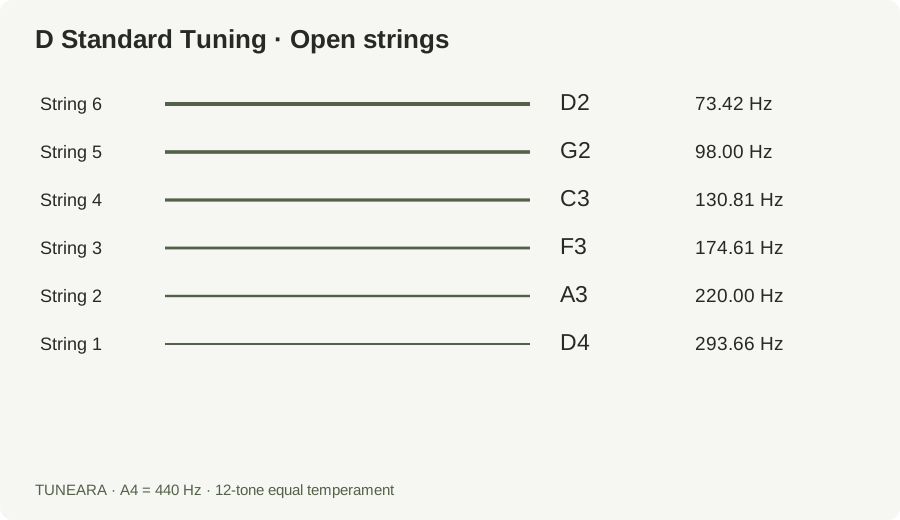
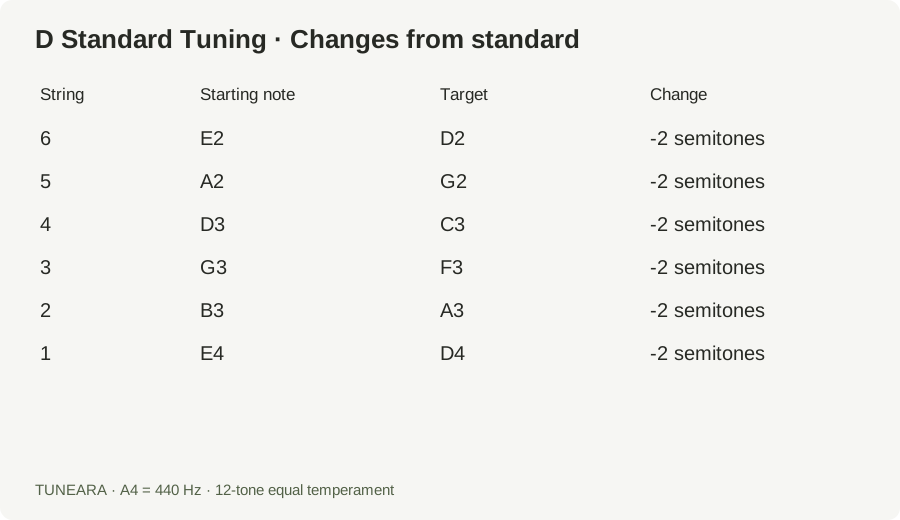
D standard tuning is D2–G2–C3–F3–A3–D4. Every string is a whole step below standard, so familiar chord shapes sound two semitones lower.
Open-string notes and frequencies
All notes below are sounding pitches in scientific pitch notation, not the octave-transposed pitches of conventional guitar staff notation. Frequencies use A4 = 440 Hz and twelve-tone equal temperament. Strings are listed from lowest pitch to highest.
| String | Target | Frequency |
|---|---|---|
| 6 | D2 | 73.42 Hz |
| 5 | G2 | 98.00 Hz |
| 4 | C3 | 130.81 Hz |
| 3 | F3 | 174.61 Hz |
| 2 | A3 | 220.00 Hz |
| 1 | D4 | 293.66 Hz |
Lower every string, not just the bass
D standard and Drop D share the same lowest open note, D2. The rest of their strings differ. D standard lowers all six strings by two semitones; Drop D changes only string 6. Read the complete tuning notation in a score or lesson before choosing targets.
Tune in gradual passes. Get each string close, then revisit the bass and work upward again. On a floating tremolo, the changing total tension moves the bridge, so earlier strings will shift while you adjust later ones.
Translate chord names into sounding pitch
The intervals between strings match standard tuning. An open E minor shape sounds D minor, and a G major shape sounds F major. Scale patterns remain usable, but their starting notes move down a whole step.
Try an E minor–C–G–D shape progression. In D standard the sounding chords are D minor–B-flat–F–C. Tell a keyboard player the sounding names, not just the guitar fingerings. That prevents a tuning choice from becoming an accidental clash between instruments.
Check the instrument after lowering tension
For unchanged strings and scale length, a whole-step drop gives roughly 79% of the original idealized tension. The strings may buzz more with a hard attack, and a neck or floating bridge may settle differently. Retuning alone cannot guarantee that the original setup will remain comfortable.
Gauge selection can help when you intend to keep this tuning. A heavier set may restore some resistance, but it can also require nut and intonation work. Choose a suitable setup rather than treating a specific gauge as mandatory.
Build a two-position listening check
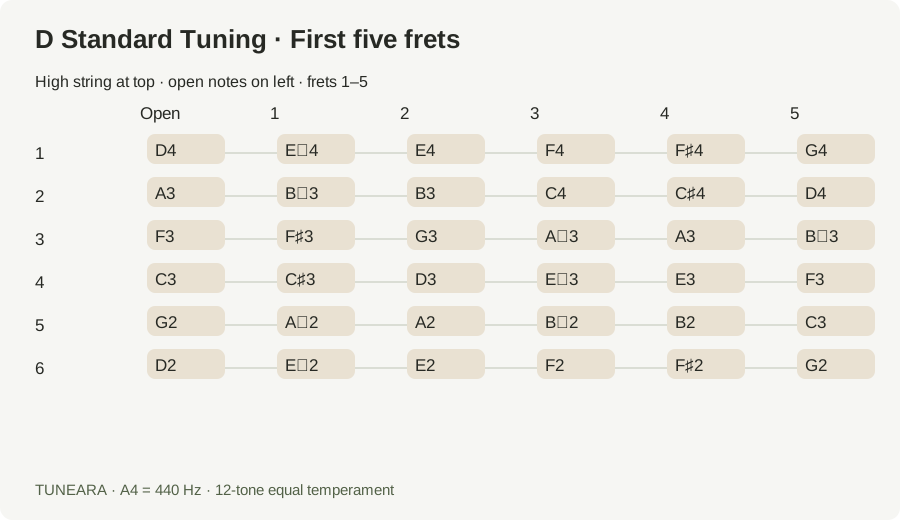
Play the open fourth string, C3, then fret the fifth string at fret 5 to find the same C3. Compare open string 2, A3, with string 3 at fret 4. The familiar fifth-fret and fourth-fret relationships remain because the whole instrument moved together.
A capo at fret 2 returns these open-with-capo pitches to standard tuning. Recheck the pitch after clamping and remember that the capo changes the effective playing length. If a song requires an even lower sixth string while retaining D-standard upper strings, see Drop C.
Compare the tuning and explore the fretboard
References and further learning

Get Tuneara
Your next practice
starts here.
A free tuner and metronome for iPhone and Android.