Drop D Tuning: Notes, Setup, and First Power Chords
← Back to Guitar tuning and fretboard notes
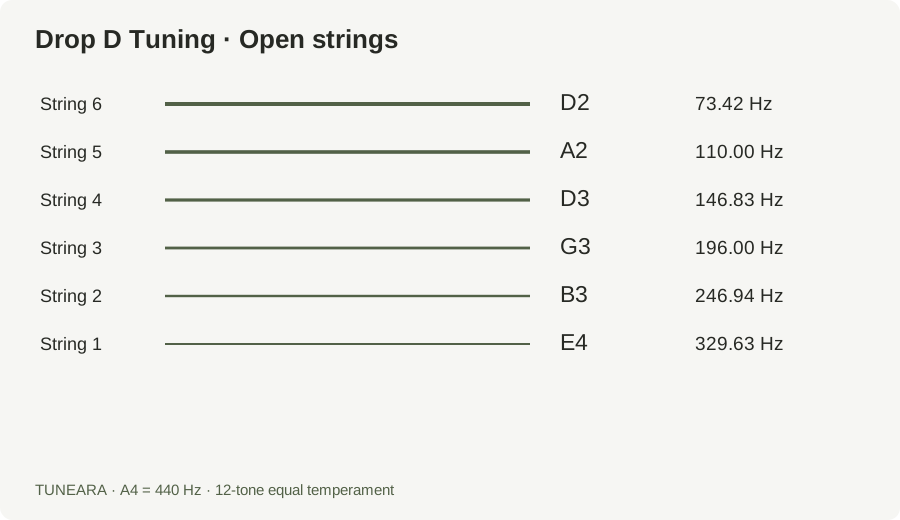
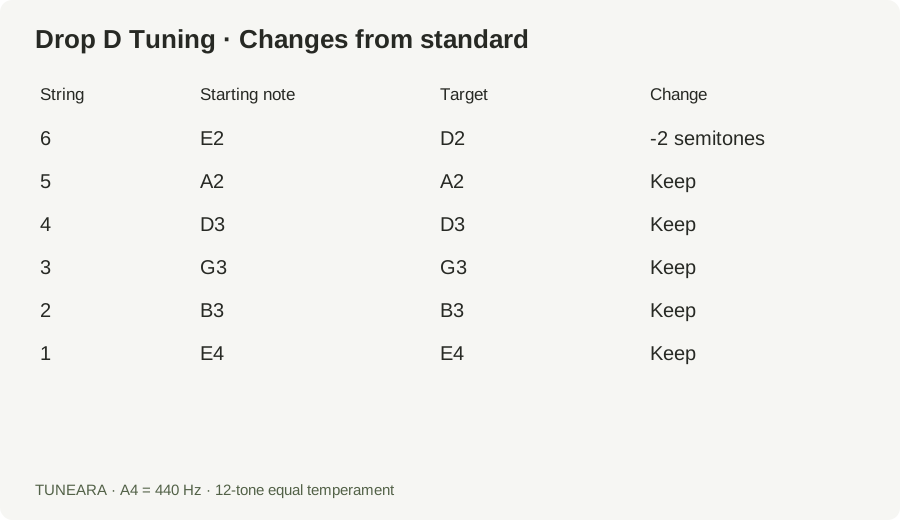
Drop D tuning is D2–A2–D3–G3–B3–E4. Lower only the sixth string from E2 to D2; the other five strings stay in standard tuning.
Open-string notes and frequencies
All notes below are sounding pitches in scientific pitch notation, not the octave-transposed pitches of conventional guitar staff notation. Frequencies use A4 = 440 Hz and twelve-tone equal temperament. Strings are listed from lowest pitch to highest.
| String | Target | Frequency |
|---|---|---|
| 6 | D2 | 73.42 Hz |
| 5 | A2 | 110.00 Hz |
| 4 | D3 | 146.83 Hz |
| 3 | G3 | 196.00 Hz |
| 2 | B3 | 246.94 Hz |
| 1 | E4 | 329.63 Hz |
Lower the sixth string a whole step
Start in standard tuning. Pluck the sixth string and loosen its tuning key gradually until it reaches D2, about 73.42 Hz. Check which key controls the string before turning it. A chromatic display may pass through E-flat on the way down; continue to the intended D, then make small corrections.
Compare low D with the fourth string, D3. They should sound an octave apart. The sixth string at fret 12 should match the open fourth string at the same pitch. This provides a useful listening check once the low string is close.
Play power chords on the lower three strings
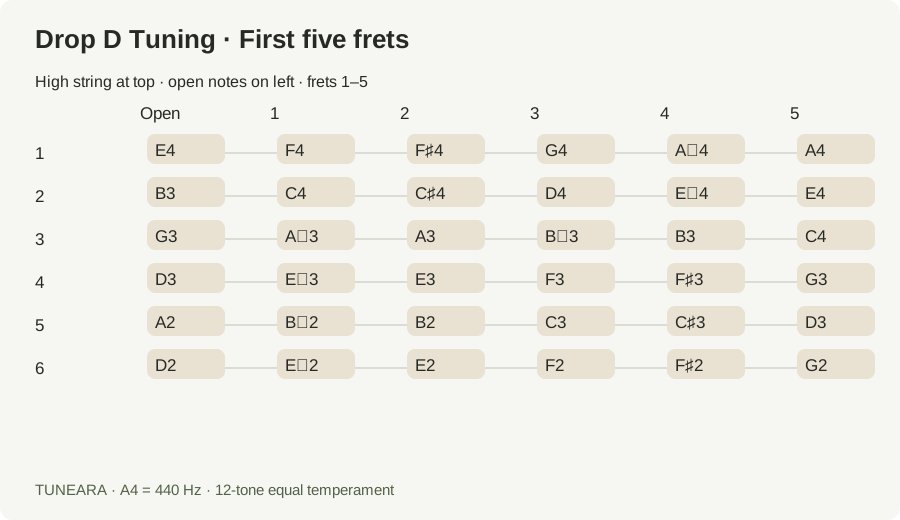
The lowest three open strings are D–A–D, a root, fifth, and octave. Played together, they form D5. Fret those three strings at fret 2 for E5, fret 3 for F5, or fret 5 for G5. Mute the upper strings if you want only the power chord.
Try two slow strums of open D5 followed by two of G5. Keep the fretting pressure light and listen for a steady bass note. A power chord has no third, so it does not establish major or minor by itself.
Keep familiar shapes where they still work
Fingerings using only strings 5 through 1 keep the same pitches as standard tuning. Shapes involving string 6 need a new bass note or a muted sixth string. A standard open G shape can produce an unintended low F if you fret the sixth string at fret 3 without thinking about the new tuning.
This is different from D standard, where every string moves down a whole step. Check the full target list when a song says “D tuning.” The name alone can be ambiguous.
Listen for a loose or sharp attack
Lowering pitch reduces tension on the same string. A strong pick attack can make the bass note start sharp before settling. Use the attack you expect to play with, let the note stabilize, and avoid chasing every instant of the meter.
If the low D feels too loose for your playing, consider string gauge and setup. Drop D is often practical on an existing standard setup, but there is no gauge that suits every scale length and playing style. Retune the other strings after the change, especially on a floating tremolo.
Compare the tuning and explore the fretboard
References and further learning

Get Tuneara
Your next practice
starts here.
A free tuner and metronome for iPhone and Android.

