Drop C Tuning: CGCFAD Notes and Setup Checks
← Back to Guitar tuning and fretboard notes
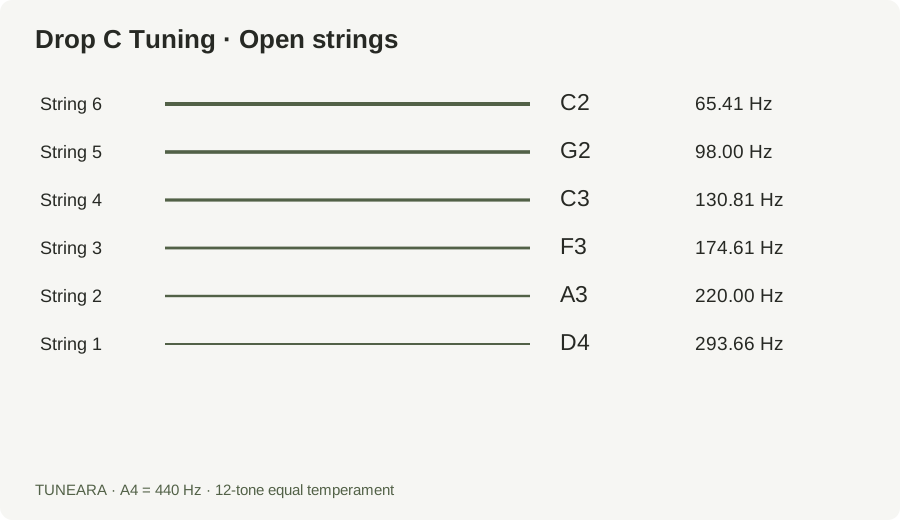
Drop C tuning is C2–G2–C3–F3–A3–D4. Tune every string down a whole step from standard, then lower the sixth string another whole step to C2.
Open-string notes and frequencies
All notes below are sounding pitches in scientific pitch notation, not the octave-transposed pitches of conventional guitar staff notation. Frequencies use A4 = 440 Hz and twelve-tone equal temperament. Strings are listed from lowest pitch to highest.
| String | Target | Frequency |
|---|---|---|
| 6 | C2 | 65.41 Hz |
| 5 | G2 | 98.00 Hz |
| 4 | C3 | 130.81 Hz |
| 3 | F3 | 174.61 Hz |
| 2 | A3 | 220.00 Hz |
| 1 | D4 | 293.66 Hz |
Use D standard as the starting map
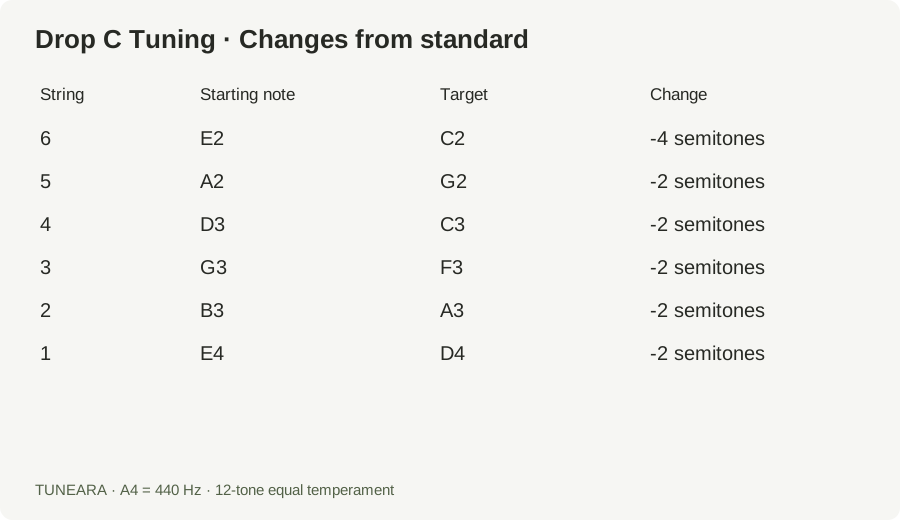
First establish D standard: D–G–C–F–A–D. Then lower the lowest D to C. Starting from standard, strings 5 through 1 move down two semitones, while string 6 moves down four.
This sequence is a way to keep the targets organized; you can tune directly to the final notes with a chromatic tuner. The lowest C2 is about 65.41 Hz. If a microphone reading jumps to C3, damp the other strings and check whether it is following a harmonic before changing tension.
Recognize the Drop D relationship
Drop C has the same relative string intervals as Drop D, with every string two semitones lower. The lowest three open strings form C5: C–G–C. Barring those strings at fret 2 gives D5 and at fret 5 gives F5.
A Drop D riff can therefore keep its fingering in Drop C while sounding a whole step lower. A standard-tuning chord shape is a different question: it must account for both the lower overall pitch and the extra drop of string 6.
Evaluate tension before choosing strings
A standard low E lowered to C retains only about 63% of its idealized original tension with the same string and scale length. That explains why a light string may feel unstable under a firm attack. It does not prove that every guitar needs the same replacement gauge.
Consider scale length, pick attack, desired feel, nut slots, bridge design, and intonation. A guitar maintained permanently in Drop C may benefit from a dedicated setup. Avoid forcing a thick string into a nut slot that does not fit.
Check the attack and the fretted notes
Pick the low C at your normal playing intensity and listen as it settles. Then compare the open note, its twelfth-fret harmonic, and the fretted twelfth-fret note. Use light pressure and retune between checks. A big mismatch on fretted notes calls for setup assessment, not just more open-string tuning.
Try a slow C5–D5–F5 progression and mute unused strings. Clear starts and stops will reveal low-string movement better than heavy distortion. If you only need occasional low D, a smaller tuning change may be easier to maintain than moving the whole guitar into Drop C.
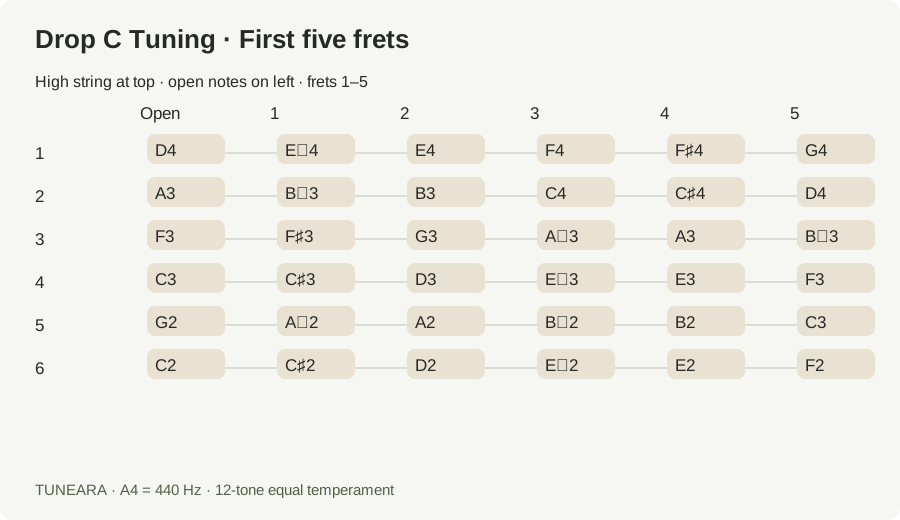
Compare the tuning and explore the fretboard
References and further learning

Get Tuneara
Your next practice
starts here.
A free tuner and metronome for iPhone and Android.