DADGAD Tuning: Notes, Drones, and Suspended Harmony
← Back to Guitar tuning and fretboard notes
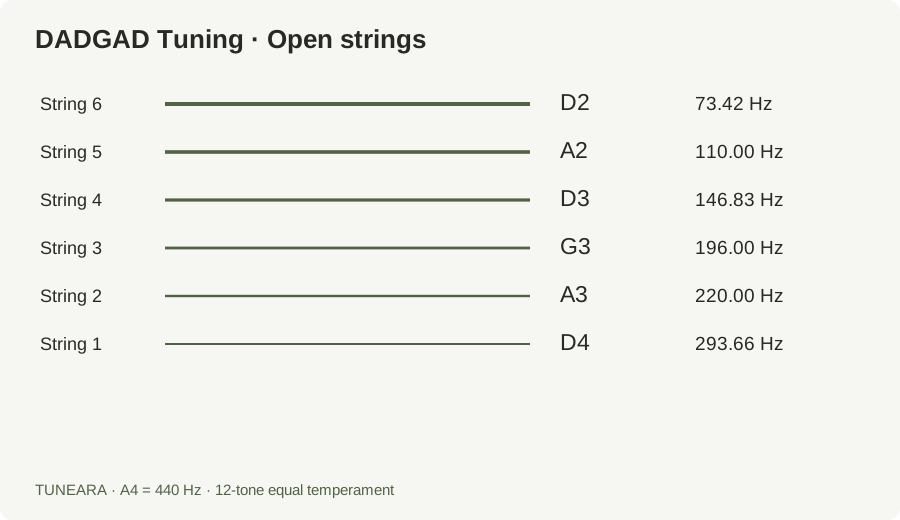
DADGAD tuning is D2–A2–D3–G3–A3–D4. Lower the sixth, second, and first strings a whole step from standard; the open sound contains no major or minor third.
Open-string notes and frequencies
All notes below are sounding pitches in scientific pitch notation, not the octave-transposed pitches of conventional guitar staff notation. Frequencies use A4 = 440 Hz and twelve-tone equal temperament. Strings are listed from lowest pitch to highest.
| String | Target | Frequency |
|---|---|---|
| 6 | D2 | 73.42 Hz |
| 5 | A2 | 110.00 Hz |
| 4 | D3 | 146.83 Hz |
| 3 | G3 | 196.00 Hz |
| 2 | A3 | 220.00 Hz |
| 1 | D4 | 293.66 Hz |
Change only three targets
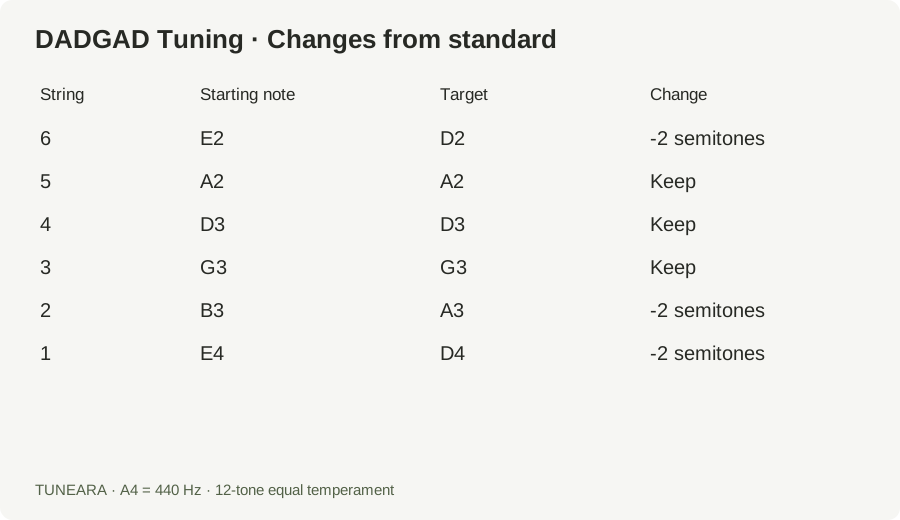
Lower the low E to D2, B to A3, and high E to D4. Keep A2, D3, and G3 unchanged. The tuning name lists strings from lowest to highest, so write D–A–D–G–A–D above your music.
Use a chromatic tuner rather than centering the standard B and E targets. Check the two A strings as an octave pair and the three D strings across their octaves. Similar note names make it especially important to confirm which string you are adjusting.
Understand the suspended open sound
Relative to D, the open strings contain the root, fifth, and fourth: D, A, and G. That collection is commonly described as Dsus4. It leaves out both F-sharp and F natural, so the open tuning does not specify D major or D minor on its own.
This is useful for drones and melodies that move between colors, but the ringing G is still a definite harmonic choice. It can clash with a passing note or chord. Listen to the whole voicing rather than assuming every open string belongs under every melody.
Try a one-finger change
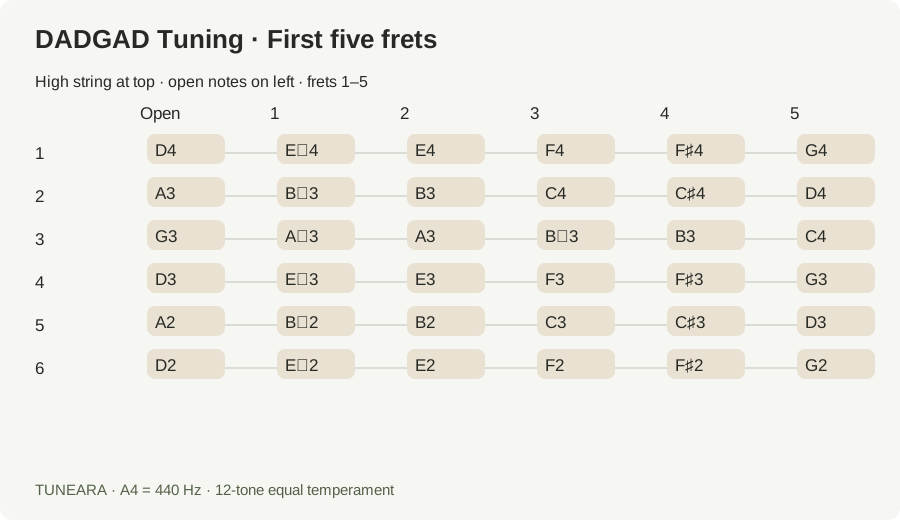
Fret string 3 at fret 2 to change G3 into A3, leaving the other strings open. You now have only D and A in the sounding collection: a D5 voicing. Alternate that shape with all strings open to hear the suspended fourth resolve to the fifth.
Next, play a melody on string 1 at frets 0, 2, 4, and 5: D4, E4, F-sharp4, and G4. Let only the low D drone continue underneath. This suggested exercise makes the melody's major third audible without requiring a full chord shape.
Use the map instead of standard chord names
The middle strings retain standard pitches, but strings 6, 2, and 1 have moved. Familiar E- and B-string fingerings therefore produce different notes. Learn the new roots and intervals before applying a name to a shape.
Compared with open D, DADGAD leaves string 3 at G instead of F-sharp. Compared with double Drop D, it lowers the B string to A. These small differences explain large changes in the open harmony. When returning to standard, restore exactly the three changed strings and recheck the entire guitar.
Compare the tuning and explore the fretboard
References and further learning

Get Tuneara
Your next practice
starts here.
A free tuner and metronome for iPhone and Android.

