Open D Tuning: DADF♯AD Notes and First Chords
← Back to Guitar tuning and fretboard notes
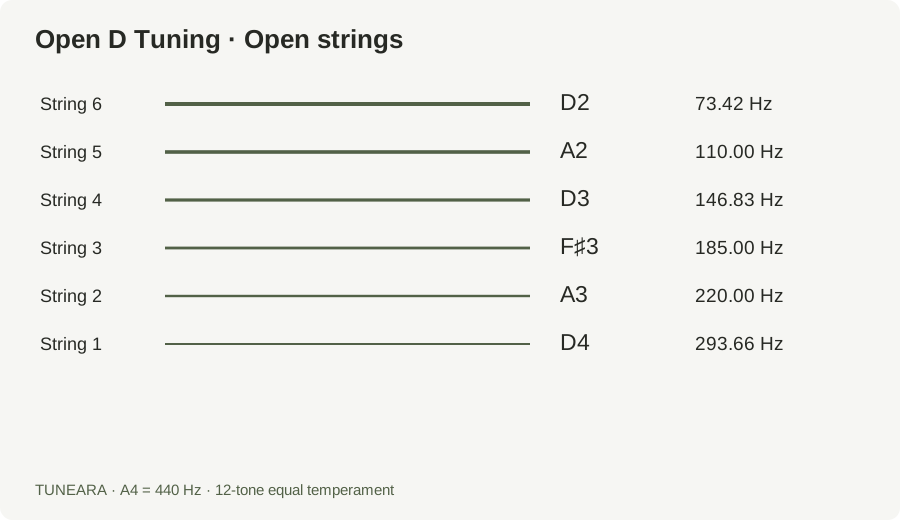
Open D tuning is D2–A2–D3–F♯3–A3–D4. Its open strings form D major, with a D root in the bass.
Open-string notes and frequencies
All notes below are sounding pitches in scientific pitch notation, not the octave-transposed pitches of conventional guitar staff notation. Frequencies use A4 = 440 Hz and twelve-tone equal temperament. Strings are listed from lowest pitch to highest.
| String | Target | Frequency |
|---|---|---|
| 6 | D2 | 73.42 Hz |
| 5 | A2 | 110.00 Hz |
| 4 | D3 | 146.83 Hz |
| 3 | F♯3 | 185.00 Hz |
| 2 | A3 | 220.00 Hz |
| 1 | D4 | 293.66 Hz |
Follow the four changed strings
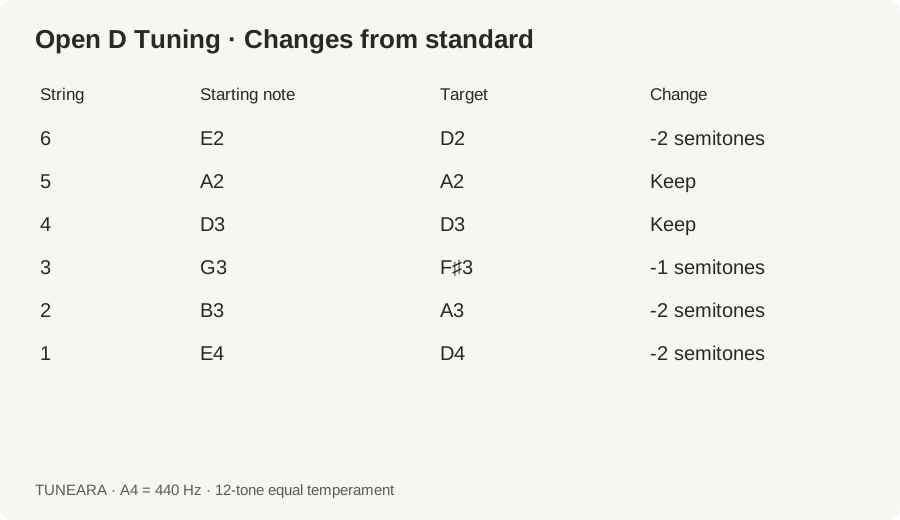
From standard tuning, lower string 6 by two semitones to D2, string 3 by one semitone to F-sharp3, string 2 by two semitones to A3, and string 1 by two semitones to D4. Strings 5 and 4 stay A2 and D3.
The third string is the easy one to overshoot. Its target is F-sharp, which a tuner may label G-flat; it is not F natural. Open D minor would contain F natural instead and is a separate tuning. Keep the exact target list nearby.
Find the major third
D, F-sharp, and A are the root, major third, and fifth of D major. Play strings 4, 3, and 2 together to hear one compact D-major triad. Then add the outside D strings to hear how the wider voicing changes its weight without changing the chord quality.
For comparison, DADGAD has G3 on string 3. That G is the fourth above D, so the open sound is suspended rather than major. Moving just one target changes the harmony substantially.
Play a simple major-chord progression
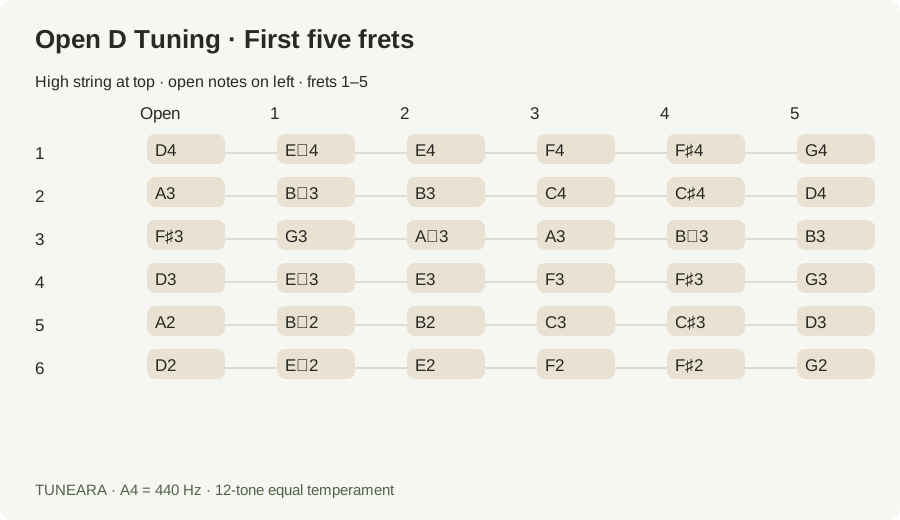
Barre all six strings at fret 5 for G major and at fret 7 for A major. Return to the open strings for D major. Keep your hand relaxed and test each string separately if the barre sounds muffled.
These straight shapes give major chords because they preserve the open tuning's interval structure. They do not automatically produce minor chords. To build a minor voicing, you need to lower the major third in the chosen shape or omit it and supply the appropriate note elsewhere.
Keep the lower tension manageable
All pitch changes from standard are downward, but the tension reduction differs by string. A familiar set can feel uneven after retuning. Use the string-gauge guide to evaluate response rather than assuming all alternate tunings need thicker strings.
Check a low D octave against the fourth string, then listen to the open major chord. If you sweeten one interval entirely by ear, other fretted chords may shift away from equal-tempered targets. Start with a consistent reference, explore the musical result, and keep any deliberate adjustment small and documented. The harmonics guide explains why exact harmonic matches and fretted tuning can differ.
Compare the tuning and explore the fretboard
References and further learning

Get Tuneara
Your next practice
starts here.
A free tuner and metronome for iPhone and Android.