Double Drop D Tuning: Change Both E Strings to D
← Back to Guitar tuning and fretboard notes
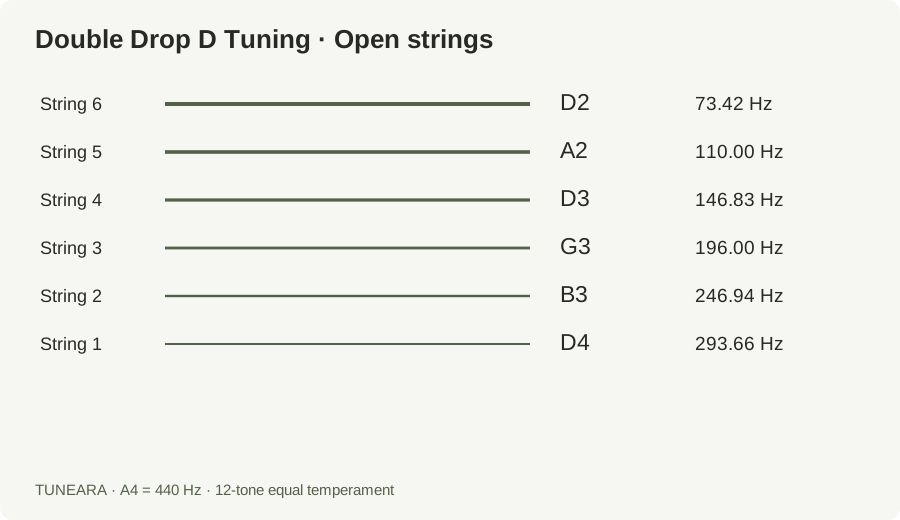
Double Drop D is D2–A2–D3–G3–B3–D4. Lower both E strings a whole step, leaving the four middle strings unchanged.
Open-string notes and frequencies
All notes below are sounding pitches in scientific pitch notation, not the octave-transposed pitches of conventional guitar staff notation. Frequencies use A4 = 440 Hz and twelve-tone equal temperament. Strings are listed from lowest pitch to highest.
| String | Target | Frequency |
|---|---|---|
| 6 | D2 | 73.42 Hz |
| 5 | A2 | 110.00 Hz |
| 4 | D3 | 146.83 Hz |
| 3 | G3 | 196.00 Hz |
| 2 | B3 | 246.94 Hz |
| 1 | D4 | 293.66 Hz |
Make the two changes deliberately
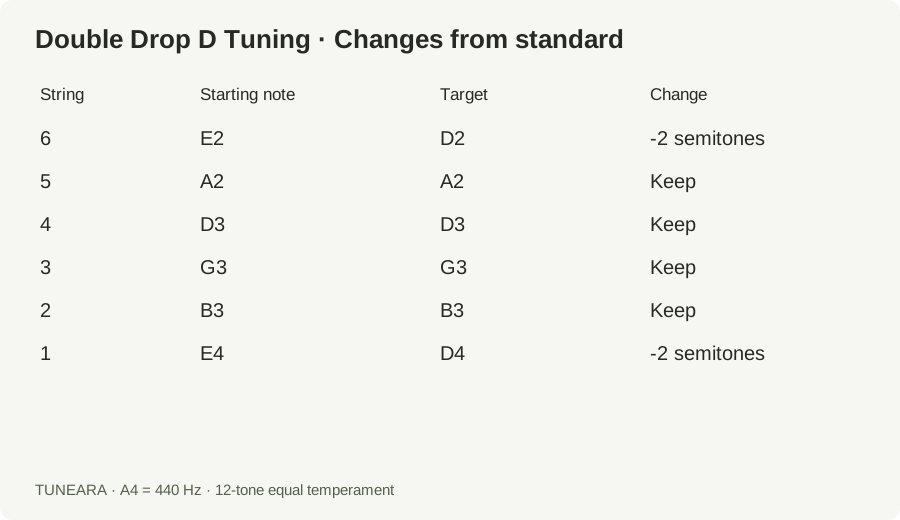
First lower the sixth string from E2 to D2. Then lower string 1 from E4 to D4. Use a chromatic tuner and verify the octave: the two outside strings are two octaves apart, even though both displays may show D.
If you already use Drop D, the only extra change is the first string. Check all six strings again afterward. With a floating bridge, one adjustment can affect the balance of the entire instrument.
Understand what the high D changes
The top three open strings are G3, B3, and D4, which form a G major triad. This does not make the whole open guitar a G major chord: the lower strings add D and A. Double Drop D is therefore different from open G, whose complete target sequence is D–G–D–G–B–D.
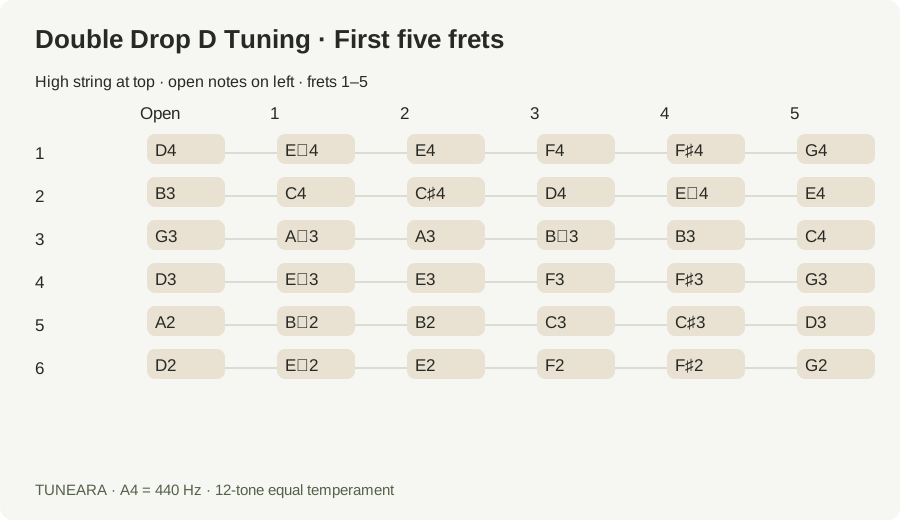
A familiar open D major shape now needs attention on the first string. Fretting that string at fret 2 gives E4, rather than the F-sharp you would get in standard tuning. Do not assume a chord name survives simply because the fingering feels familiar.
Try a drone exercise
Play the open first string softly, then pick notes on string 2 at frets 0, 1, and 3: B3, C4, and D4. Let the D drone ring while you hear each interval. Add the open sixth string only when you can keep the melody clear.
This suggested exercise explores the tuning; it is not a complete chord progression. Listen for the difference between a repeated reference pitch and a moving melody. Muting matters as much as sustain when you want a deliberate harmony.
Choose it for a specific musical reason
Double Drop D keeps the middle four strings familiar while adding a low D bass and a high D drone. It can suit arrangements centered on D or G, but the tuning does not determine the key of everything you play.
Write “D A D G B D” above your tab and circle both changed strings. When returning to standard, raise each outside string only a whole step. Recheck the first string particularly carefully: its D4 target in this tuning should never be confused with low D2. For a wider drone texture without the B natural, compare DADGAD.
Compare the tuning and explore the fretboard
References and further learning

Get Tuneara
Your next practice
starts here.
A free tuner and metronome for iPhone and Android.