Open G Tuning: DGDGBD Notes and Chord Basics
← Back to Guitar tuning and fretboard notes
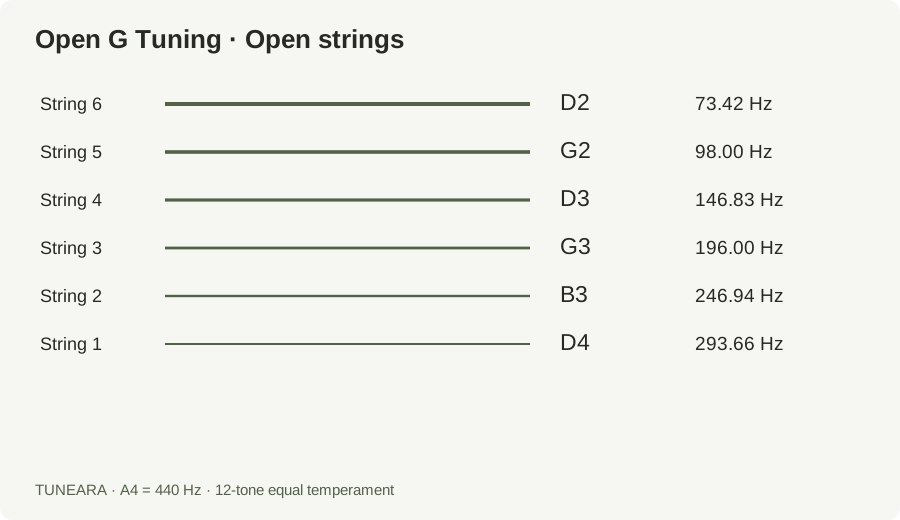
Open G tuning is D2–G2–D3–G3–B3–D4. The open strings contain G, B, and D, so strumming them gives a G major chord with D in the bass.
Open-string notes and frequencies
All notes below are sounding pitches in scientific pitch notation, not the octave-transposed pitches of conventional guitar staff notation. Frequencies use A4 = 440 Hz and twelve-tone equal temperament. Strings are listed from lowest pitch to highest.
| String | Target | Frequency |
|---|---|---|
| 6 | D2 | 73.42 Hz |
| 5 | G2 | 98.00 Hz |
| 4 | D3 | 146.83 Hz |
| 3 | G3 | 196.00 Hz |
| 2 | B3 | 246.94 Hz |
| 1 | D4 | 293.66 Hz |
Lower three strings from standard
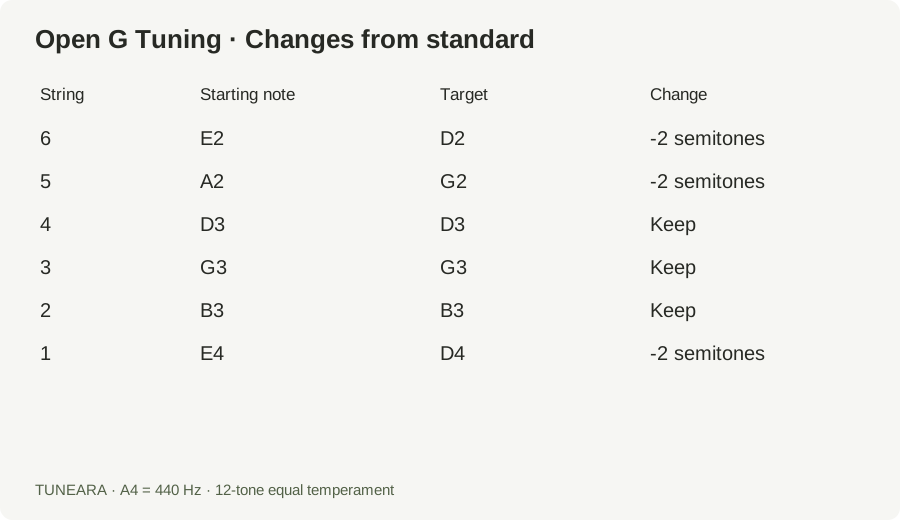
Lower string 6 from E2 to D2, string 5 from A2 to G2, and string 1 from E4 to D4. Strings 4, 3, and 2 remain D3, G3, and B3. Work in small steps and check the full set once the new pitches are close.
Some arrangements omit or mute string 6, leaving G2 as the lowest sounding note. A six-string open-G chart should still state the sixth-string target. Muting that D is a musical voicing choice, not a different pitch for the string.
Hear the major chord inside the tuning
G is the root, B is its major third, and D is its fifth. With all six strings ringing, the lowest note is D, producing a G major chord in second inversion. If you want a root-position G sound, start your strum on string 5.
Compare DADGAD: it leaves the third out of its open D-centered sound. Open G already contains a major third, so ringing every string underneath a minor melody can create a clash you need to handle deliberately.
Move one shape across the neck
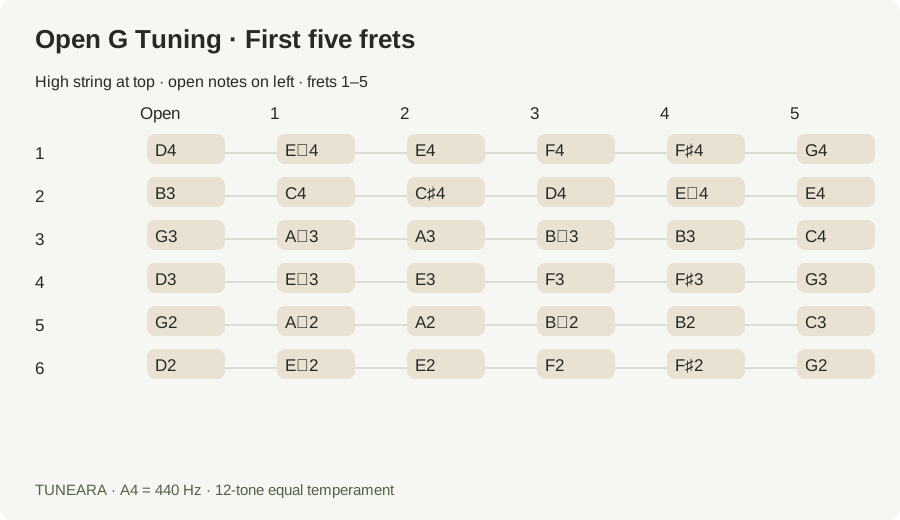
A straight barre across all strings at fret 5 gives C major with G in the bass. Fret 7 gives D major with A in the bass. For root-position versions, mute string 6 and strum strings 5 through 1.
Try open G, fret-5 C, and fret-7 D slowly. Start with a fretted barre, using only enough pressure for clear notes. If you explore slide afterward, place the slide above the fret wire rather than in the space behind it, and listen carefully to its position. Slide intonation is controlled continuously by your hand.
Relearn the changed strings
The middle three strings preserve their standard-tuning pitches, but the outside strings and fifth string do not. Use the note map to locate roots instead of transferring every standard shape unchanged. The new fifth-string G is especially helpful as an anchor for chord names.
Label tab with “D G D G B D” and note any muted strings. When returning to standard, raise only strings 6, 5, and 1 to their original targets. If you prefer a similar open-major layout centered on D, compare open D, which changes a different set of strings.
Compare the tuning and explore the fretboard
References and further learning

Get Tuneara
Your next practice
starts here.
A free tuner and metronome for iPhone and Android.