The Circle of Fifths: Keys, Signatures, and Neighbors
← Back to Music scales and keys
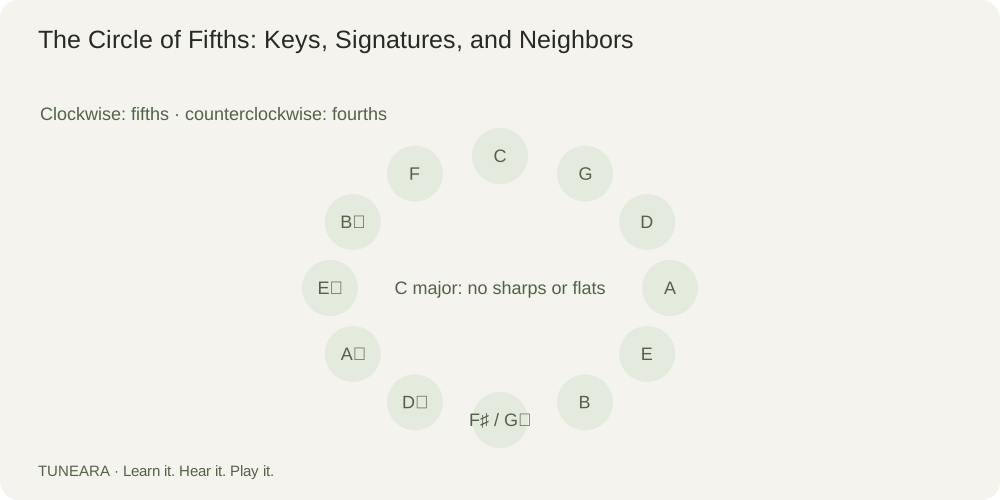
The circle of fifths arranges pitch classes and keys by fifths. Moving clockwise through common major keys adds sharps; moving counterclockwise adds flats.
How to read the circle of fifths
Start with C and move up a perfect fifth to G, then D, A, E, and B. The familiar key-signature chart continues through enharmonic alternatives before returning to C. The circle organizes key relationships, not a command to perform every melody in fifths. Neighboring keys share many pitches.
Compare the key signatures of C, G, D, F, and B-flat
C major has no sharps or flats, G major has F-sharp, and D major adds C-sharp. Counterclockwise, F major has B-flat and B-flat major adds E-flat. Six-sharp F-sharp major and six-flat G-flat major are enharmonic alternatives in equal temperament, with different written spellings.
| Major key | Relative minor | Key signature |
|---|---|---|
| C | A minor | No sharps or flats |
| G | E minor | F♯ |
| D | B minor | F♯, C♯ |
| A | F♯ minor | F♯, C♯, G♯ |
| F | D minor | B♭ |
| B♭ | G minor | B♭, E♭ |
| E♭ | C minor | B♭, E♭, A♭ |
To find a major key’s relative minor, take its sixth scale degree. For the full sharp and flat orders, read how to read key signatures. To compare the two tonal centers, try relative major and minor.
Try it in practice
Write C–G–D–A and list each key’s signature. Then write C–F–B-flat–E-flat and list the flats. Choose one pair of neighboring keys and compare their scales: identify the single altered pitch. Play a short phrase in both keys so the chart connects to a sounding transposition.
Avoid a common mistake
Do not assume a circle position proves the key of a particular piece. Relative minor shares a signature, modes can use the same collection, and accidentals can move outside it. Also distinguish a fifth-based key chart from a chord progression: progression direction and harmonic function need musical context.
Read the visual example
What to learn next
Connect this lesson to Whole Steps and Half Steps: Count Musical Distance, then try Scale Degrees: Name Notes by Their Role in a Key.
References and further learning

Get Tuneara
Your next practice
starts here.
A free tuner and metronome for iPhone and Android.