How to Tune New Guitar Strings and Help Them Settle
← Back to Guitar tuning and fretboard notes
Tune new guitar strings to their intended notes in gradual passes, check that their attachment points are secure, and retune as they settle. Follow your instrument and string maker’s installation guidance rather than pulling hard on the strings.
Confirm the string set and installation
Check the package for the instrument, gauge, and intended use. Nylon and steel strings are not interchangeable on every guitar. Match each string to its position before tuning; a wrong string on a post can make the expected pitch unsafe or impractical.
Bridge pins, tie blocks, locking bridges, locking posts, and traditional posts have different installation requirements. Use the maker's procedure. On a pinned acoustic bridge, the ball end should seat against the bridge plate, rather than hanging loosely from the pin tip.
Bring the set up gradually
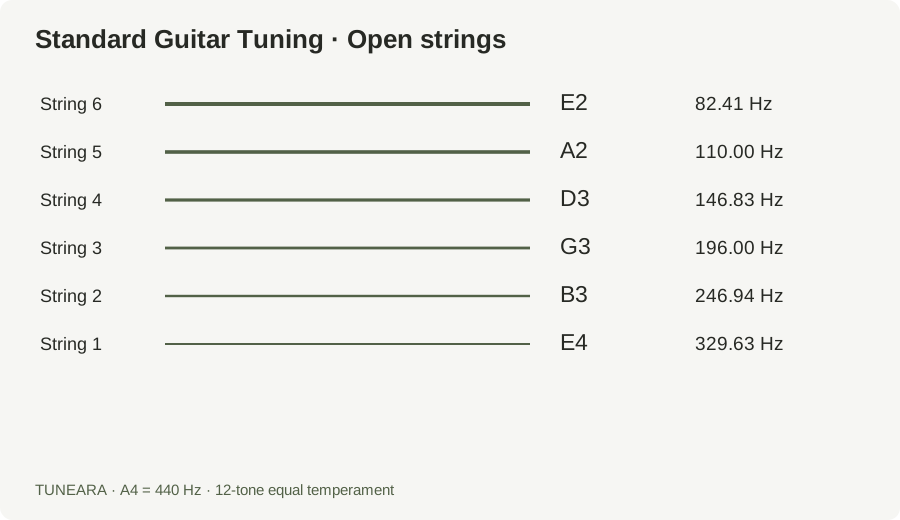
Use standard targets or the exact alternate tuning you intend to keep. Raise each string toward its target in small stages, then revisit the whole set. Avoid bringing one string far above pitch to compensate for movement elsewhere.
Identify the octave by listening as well as reading the tuner. A loose string can produce a confusing signal, and a strong harmonic may be detected an octave high. Stop if tension feels unexpectedly high or the note does not make sense for the string.
Settle gently and retune
Once near pitch, play lightly and recheck. If the maker recommends gentle manual stretching for that string type, use controlled movements and retune afterward. Aggressive pulling can damage a string or disturb an attachment point; more force is not a shortcut to a stable setup.
Nylon strings can take longer to settle than steel strings, and different instruments behave differently. There is no universal number of minutes or stretches that guarantees stability. Look for progressively smaller changes over repeated normal playing checks.
Find the reason for continuing drift
If a string repeatedly drops far in pitch, inspect whether the post wraps or bridge attachment are slipping. If it jumps or pings during adjustment, friction may be involved. If all strings move when one is tuned, a floating bridge can be redistributing tension.
Use the stability diagnostic to separate these patterns. Do not assume every new-string problem will disappear with more stretching. Correct installation and a suitable setup matter more than a fixed ritual.
Check the finished instrument
After the strings settle reasonably, test open chords and twelfth-fret intonation. If the new set has a different gauge or construction, the instrument may need setup changes. A familiar tuning with a new set is not necessarily the same mechanical condition as before.
Wipe strings after practice and inspect for corrosion, kinks, or damaged windings. Change strings based on condition and your playing needs rather than a universal calendar. Keep the package details so you can reproduce a set that works well for your guitar.
References and further learning

Get Tuneara
Your next practice
starts here.
A free tuner and metronome for iPhone and Android.