How a Capo Changes Guitar Tuning and Chord Pitch
← Back to Guitar tuning and fretboard notes
A capo raises the open-with-capo pitch of every string by one semitone per fret. Tune the guitar first, place the capo close behind the fret, and check pitch again with the capo installed.
Count semitones from the original tuning
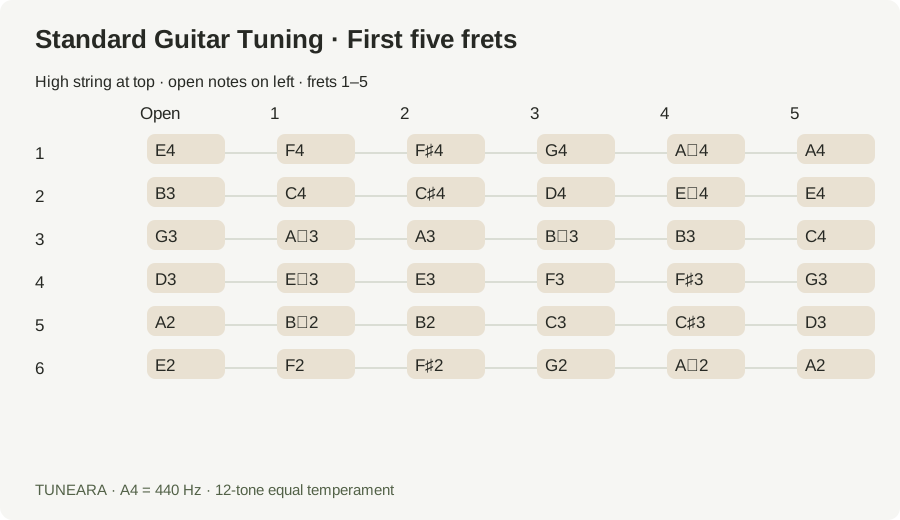
In standard tuning, a capo at fret 1 gives F2–B-flat2–E-flat3–A-flat3–C4–F4. At fret 2 it gives F-sharp2–B2–E3–A3–C-sharp4–F-sharp4. The strings have not been retuned to a new open-string tension target; their effective vibrating length is shorter.
This same arithmetic works for alternate tunings. A capo raises each existing target by the same number of semitones. It does not turn Drop D into standard tuning, because the altered sixth-string interval remains.
Position the capo with minimal distortion
Tune without the capo. Place it close behind the selected fret wire, leaving room for a clean contact without clamping directly on top of the wire. Keep it parallel to the fret and avoid dragging strings sideways while attaching it.
If the capo has adjustable pressure, use only enough for clean notes. Excess force can stretch the strings sharp, particularly with tall frets or high action. A capo whose radius poorly matches the fingerboard may clamp unevenly.
Translate shapes into concert pitch
A G major shape with a capo at fret 2 sounds A major. A C major shape there sounds D major, and an E minor shape sounds F-sharp minor. The shape name tells a guitarist what to finger; the sounding name tells the ensemble what harmony it hears.
Try the shapes G–D–E minor–C at capo 2. The sounding progression is A–E–F-sharp minor–D. Tell a keyboardist the second list. If a chord chart supplies only shape names, write the capo position prominently at the top.
Retune for the actual performance setup
After clamping, pick each string and check its raised target. If all strings are slightly sharp, first reseat the capo with less pressure instead of immediately changing six tuning keys. If you do make corrections with the capo on, recheck the guitar after removing it.
A capo can expose existing intonation or action issues. One stubborn string may need a placement adjustment, a different capo fit, or a setup assessment. The display alone cannot tell which cause applies.
Use a capo to compare tunings
On a guitar tuned half a step down, capo 1 returns the open-with-capo pitches to standard. On D standard, capo 2 does the same. These are helpful arrangement choices when you want familiar shapes but need a different sounding key.
Keep a note of both the base tuning and capo fret. “Capo 2” does not fully specify the sounding pitches unless the underlying tuning is known.
References and further learning

Get Tuneara
Your next practice
starts here.
A free tuner and metronome for iPhone and Android.

