Half-Step-Down Guitar Tuning: E-flat Standard
← Back to Guitar tuning and fretboard notes
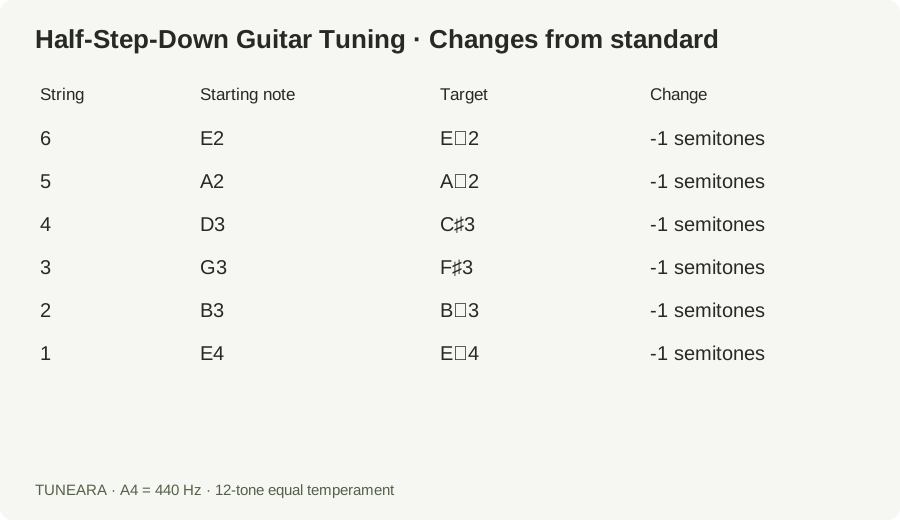
Half-step-down tuning lowers every standard guitar string by one semitone: E♭2–A♭2–D♭3–G♭3–B♭3–E♭4. It is also called E-flat standard.
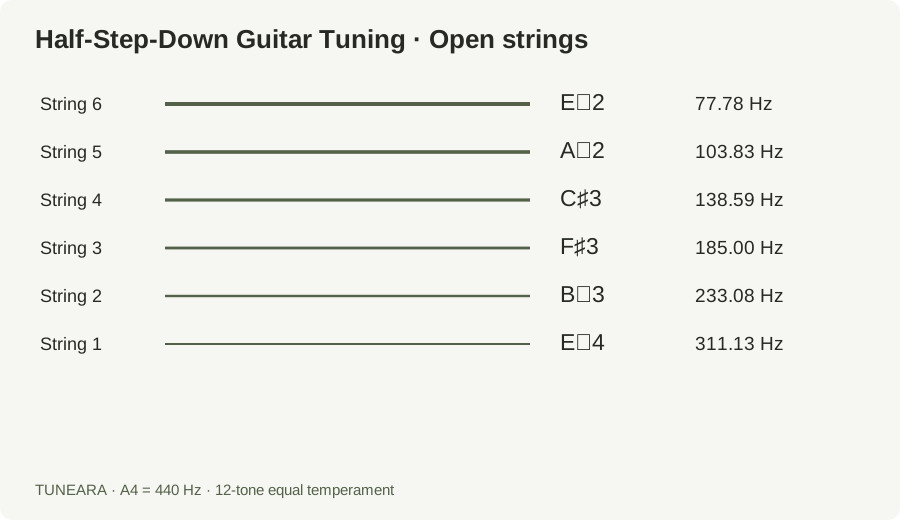
Open-string notes and frequencies
All notes below are sounding pitches in scientific pitch notation, not the octave-transposed pitches of conventional guitar staff notation. Frequencies use A4 = 440 Hz and twelve-tone equal temperament. Strings are listed from lowest pitch to highest.
| String | Target | Frequency |
|---|---|---|
| 6 | E♭2 | 77.78 Hz |
| 5 | A♭2 | 103.83 Hz |
| 4 | C♯3 | 138.59 Hz |
| 3 | F♯3 | 185.00 Hz |
| 2 | B♭3 | 233.08 Hz |
| 1 | E♭4 | 311.13 Hz |
Set all six targets before turning the keys
Use a chromatic tuner and write down the new notes in string 6-to-1 order. A display using sharps may show D-sharp, G-sharp, C-sharp, F-sharp, A-sharp, and D-sharp. In equal temperament those are the same target frequencies as the flat spellings in this guide.
Lower each string by one semitone, then repeat the whole set. If your tuner has a transposition setting, understand whether it is changing the displayed note name or the actual reference. It is often simpler to leave A4 at 440 Hz and tune to the explicit flat notes.
Keep the shapes and transpose the sound
All intervals between strings remain the same as standard tuning. Standard chord and scale fingerings still work, but every sounding note is one semitone lower. An E major shape sounds E-flat major; an A minor shape sounds A-flat minor.
When playing with another musician, distinguish a shape name from a concert-pitch chord name. Saying “play E” can cause confusion if one guitar is tuned down and the other is not. Share both your tuning and the sounding key before starting.
Use a capo when you need standard pitch
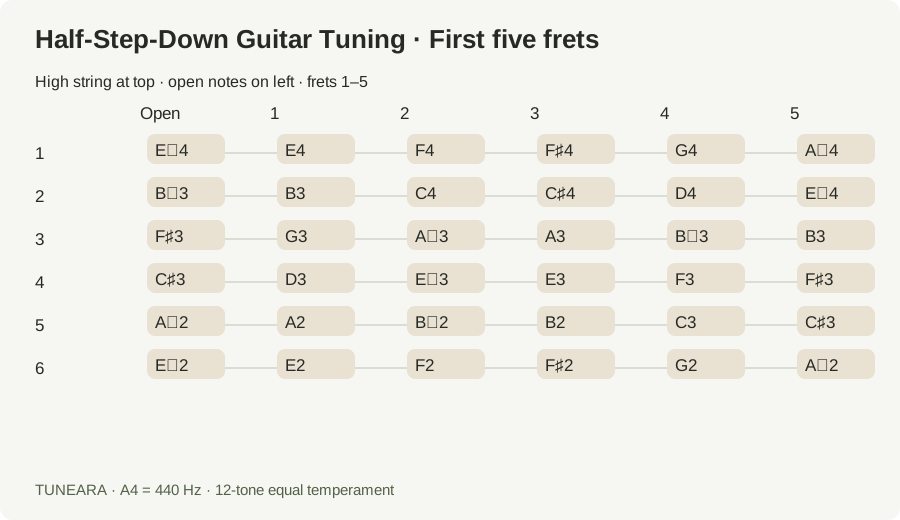
A capo at fret 1 raises every string by one semitone, returning the open-with-capo notes to the pitches of standard tuning. Your available fretboard becomes one fret shorter, and the feel changes because the capo becomes the new open-string boundary.
Check capo tuning after installing it. Excess clamping pressure or sideways string movement can make notes sharp. A capo is convenient, but it does not make an instrument immune to intonation problems.
Expect a modest change in feel
On the same strings and scale length, dropping one semitone reduces idealized tension to about 89% of its previous value. Real playing feel also depends on string construction, action, and technique. The change may feel comfortable without requiring a different gauge, but evaluate your own instrument.
Practice one chord progression first in standard and then down a half step. Notice the lower sounding key and the lighter response separately. If you need another semitone of downward transposition, use D standard and recheck the setup rather than repeatedly guessing lower targets.
Compare the tuning and explore the fretboard
References and further learning

Get Tuneara
Your next practice
starts here.
A free tuner and metronome for iPhone and Android.