Guitar Tuning Frequencies: String Hz Chart and Cents
← Back to Guitar tuning and fretboard notes
At A4 = 440 Hz, standard guitar frequencies are approximately 82.41, 110.00, 146.83, 196.00, 246.94, and 329.63 Hz. Use frequency ratios, rather than fixed hertz offsets, to compare musical pitch distances.
| String | Open note | Frequency |
|---|---|---|
| 6 (lowest) | E2 | 82.41 Hz |
| 5 | A2 | 110.00 Hz |
| 4 | D3 | 146.83 Hz |
| 3 | G3 | 196.00 Hz |
| 2 | B3 | 246.94 Hz |
| 1 (highest) | E4 | 329.63 Hz |
These are sounding fundamental frequencies in twelve-tone equal temperament, rounded to two decimal places. For the string order and tuning steps, start with standard guitar tuning. The calculations below explain how to change the reference or interpret a cents reading.
Calculate a target from A4
In twelve-tone equal temperament, each semitone multiplies frequency by the twelfth root of two. For a note n semitones above A4, frequency is 440 × 2^(n/12). Use a negative n for a note below A4. Guitar A2 is 24 semitones below A4, giving 440 ÷ 4 = 110 Hz.
The standard guitar chart lists all six string targets. The displayed frequencies are rounded to two decimal places for readability; the underlying calculation is more precise. A rounding difference is not a new temperament.
Convert a reading into cents
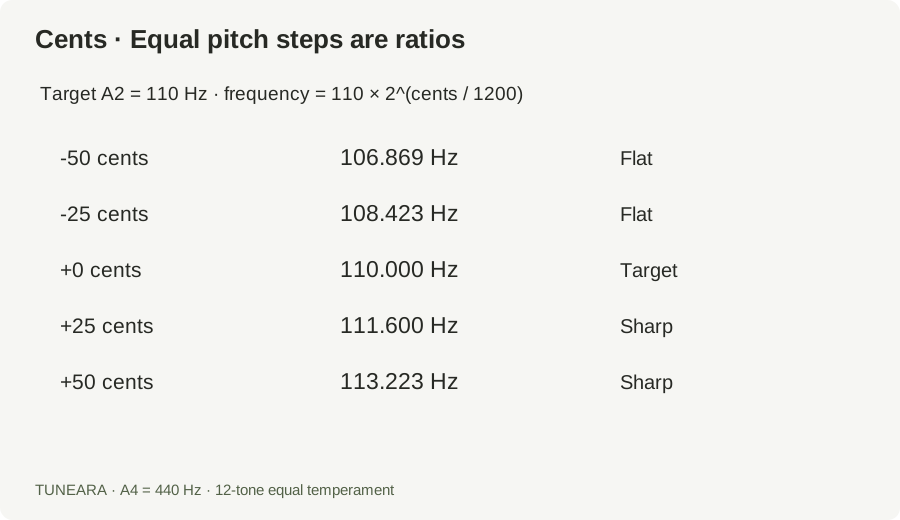
Cents measure a ratio. The difference from a target is 1,200 × log₂(measured frequency ÷ target frequency). A reading above the target gives positive cents; one below gives negative cents.
If A2 measures 111 Hz instead of 110 Hz, it is about 15.67 cents sharp. A fixed 1 Hz difference is a smaller interval higher up: 441 Hz compared with 440 Hz is about 3.93 cents sharp. This is why a useful tuner presents musical deviation rather than only a raw hertz error.
Change the reference consistently
If an ensemble chooses A4 = 442 Hz, multiply every 440-based target by 442/440. A2 then becomes 110.50 Hz and E2 becomes about 82.78 Hz. The entire system moves by about 7.85 cents; you do not add 2 Hz to every guitar string.
Agree on the reference before playing together. Changing A4 calibration is different from half-step-down tuning, which lowers targets by 100 cents. Check whether your tuner lets you set the agreed A4 reference before using it with the ensemble.
Keep fundamental and harmonics separate
An open low E has a fundamental near 82.41 Hz. Its ideal second partial is about 164.81 Hz, and its fourth is about 329.63 Hz. A detector can sometimes follow a strong partial instead of the fundamental, producing an octave-related reading.
That does not mean you should tighten the string to the displayed octave. Damp nearby strings and play a clean note. For the relationship between partials and string comparisons, see harmonic tuning.
Use numbers to answer a musical question
A target table can confirm the intended note, octave, and reference. It cannot guarantee the accuracy of every fretted chord, diagnose a setup, or choose the best expressive pitch in an ensemble. For those questions, combine consistent measurement with listening.
Try calculating one target and checking it against the chart. Then convert a small error into cents. That short exercise makes the tuner easier to interpret without treating a flickering last decimal place as a performance goal.
References and further learning

Get Tuneara
Your next practice
starts here.
A free tuner and metronome for iPhone and Android.