Seven-String Guitar Tuning: Standard BEADGBE
← Back to Guitar tuning and fretboard notes
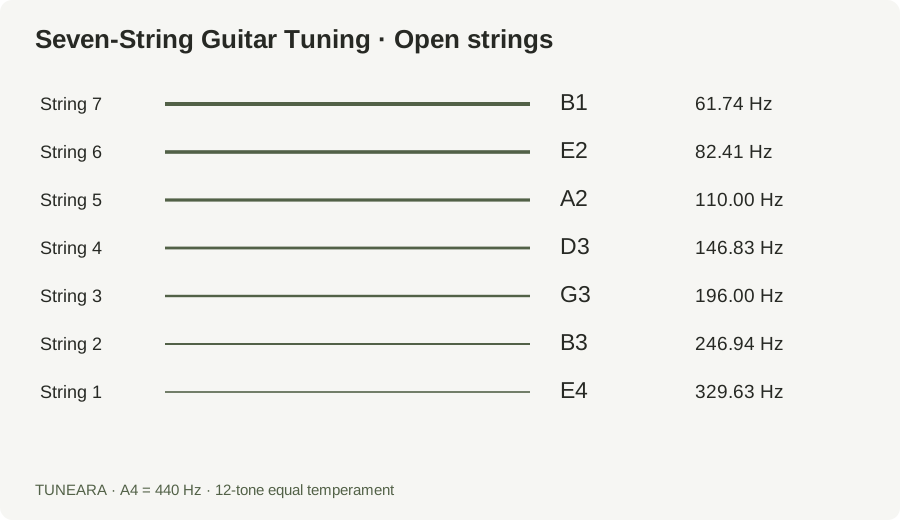
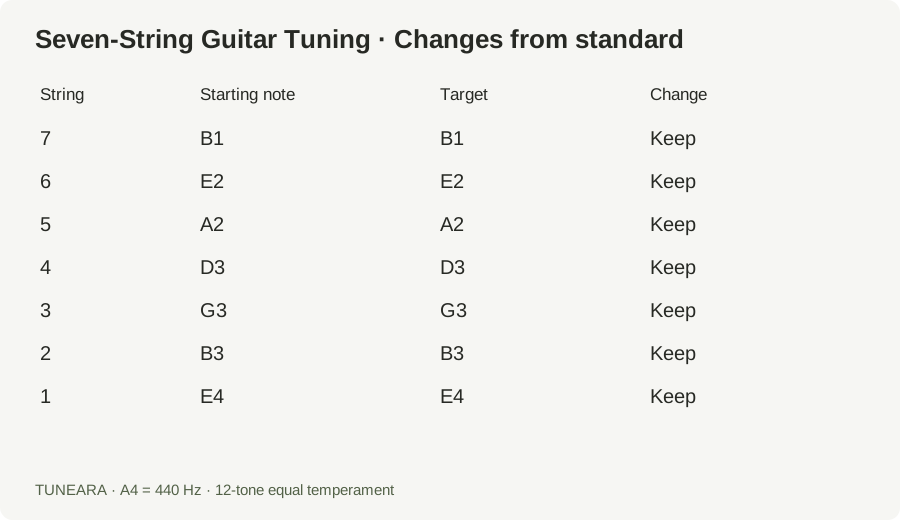
Common seven-string standard tuning is B1–E2–A2–D3–G3–B3–E4. It adds a low B below the six strings of a standard guitar.
Open-string notes and frequencies
All notes below are sounding pitches in scientific pitch notation, not the octave-transposed pitches of conventional guitar staff notation. Frequencies use A4 = 440 Hz and twelve-tone equal temperament. Strings are listed from lowest pitch to highest.
| String | Target | Frequency |
|---|---|---|
| 7 | B1 | 61.74 Hz |
| 6 | E2 | 82.41 Hz |
| 5 | A2 | 110.00 Hz |
| 4 | D3 | 146.83 Hz |
| 3 | G3 | 196.00 Hz |
| 2 | B3 | 246.94 Hz |
| 1 | E4 | 329.63 Hz |
Identify the added seventh string
On this layout, string 1 remains the thin high E4 and string 7 is the low B1, about 61.74 Hz. Strings 6 through 1 use the same notes as six-string standard tuning. Check your instrument's intended setup before assuming every seven-string uses this arrangement.
A tuner needs to handle the low B's range. Strong overtones can make it display B2 instead of B1. Dampen adjacent strings, play a moderate single note, and let it settle. Never raise the string an octave just to force the octave label on a display.
Keep familiar shapes on six strings
Standard chord shapes work on strings 6 through 1 when the seventh string is muted. Letting the low B ring under an E major shape gives a different bass and voicing. It is not automatically a wrong note, but it needs to be intentional.
Practice one familiar progression while resting your picking hand or another available finger lightly against string 7. Then add the low B only on a chord where you want that pitch. Extended range creates extra muting work as well as extra notes.
Find the new low-string relationships
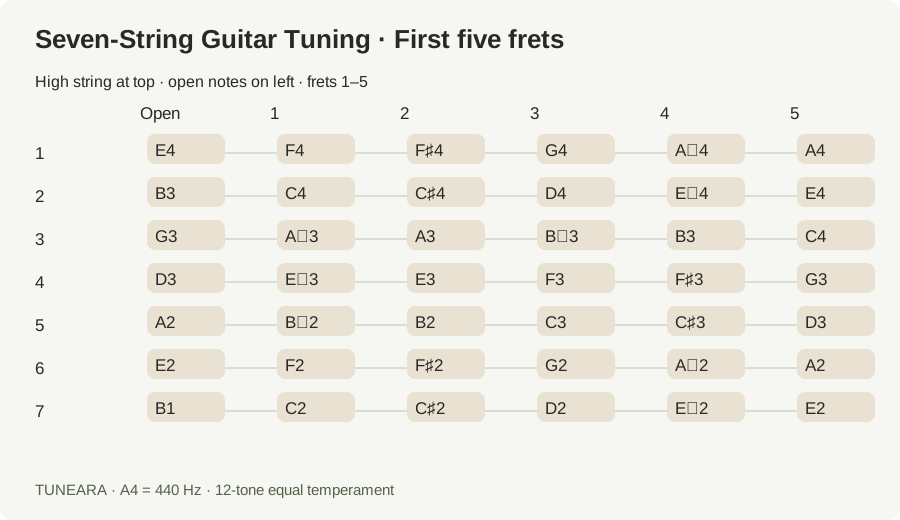
The seventh-string fifth fret is E2, matching open string 6. Its twelfth fret is B2, an octave above the open seventh string. These are useful reference points for both tuning and note learning.
The G–B major-third boundary remains between strings 3 and 2. Adding a low B does not make every string pair a fourth. Move a familiar low-string power-chord shape onto strings 7 and 6, then check the notes slowly rather than assuming the same fingering works across every pair.
Distinguish standard from Drop A
A common Drop A arrangement is A1–E2–A2–D3–G3–B3–E4: only the seventh string moves down a whole step from this standard layout. Other low tunings may change more strings. Always compare complete target lists.
The low string's gauge and the guitar's scale length strongly affect how a lowered pitch feels. Use gauge and tuning principles to assess your setup, and avoid forcing a low note onto an unsuitable string. Check intonation at your normal fretting pressure before deciding the tuner is at fault.
Compare the tuning and explore the fretboard
References and further learning

Get Tuneara
Your next practice
starts here.
A free tuner and metronome for iPhone and Android.