Guitar Fretboard Notes: First Five Frets and Octaves
← Back to Guitar tuning and fretboard notes
Each guitar fret raises an open string by one semitone. Learn the open targets first, count through the twelve-note cycle, and use matching pitches on neighboring strings to connect the fretboard to your ear.
Begin with sounding pitches
Standard open strings are E2, A2, D3, G3, B3, and E4. These octave labels describe what you hear. Traditional guitar staff notation is normally written an octave above sounding pitch, so a score and a frequency table may use different octave conventions.
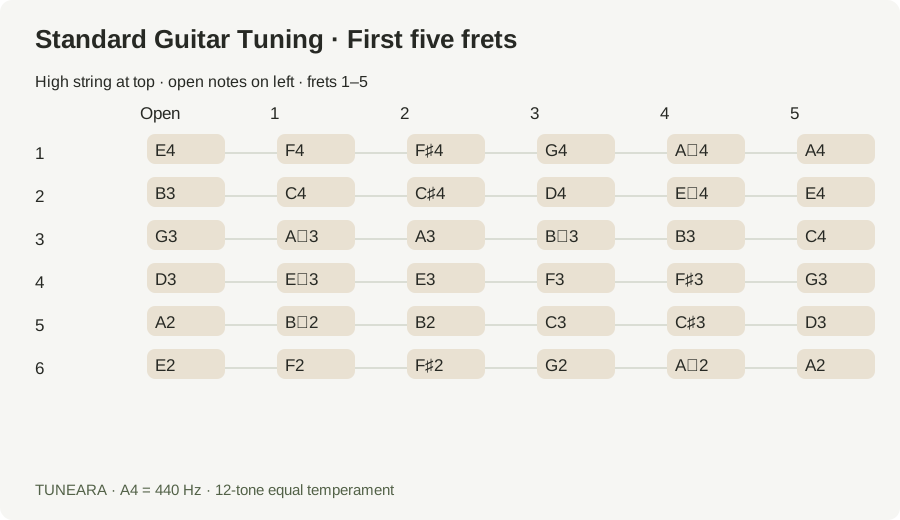
String numbers run from the highest thin string, 1, to the lowest thick string, 6. On the map below, string 1 appears at the top, as in common tab layouts. Always check a diagram's labels rather than assuming its orientation.
Count one fret at a time
The pitch-class cycle is C, C-sharp, D, E-flat, E, F, F-sharp, G, A-flat, A, B-flat, B, then C. Some notes have other spellings, such as D-flat instead of C-sharp. In equal temperament those spellings share a frequency.
On low E, frets 1 through 5 give F2, F-sharp2, G2, A-flat2, and A2. Notice that E–F and B–C are already one semitone apart. Inserting an extra note between either pair will put your map off by one fret.
Find the same pitch on another string
The low E string at fret 5 matches open A2. The A string at fret 5 matches open D3. The D string at fret 5 matches open G3. The G string at fret 4 matches open B3, and the B string at fret 5 matches open E4.
These unisons are the basis of fifth-fret ear tuning. Play a pair slowly and listen for whether the notes actually match. The same letter in a different octave is a different pitch, so keep the octave number in mind during the exercise.
Use fret 12 as an octave landmark
Twelve semitones double frequency, so fret 12 gives the same note name one octave above the open string. The low E becomes E3, while high E becomes E5. Notes repeat above fret 12 with that higher octave relationship.
The ideal equal-tempered fret position is based on a frequency ratio, not equal physical spacing between frets. The spaces get smaller toward the bridge. Actual string stretching and setup mean a real fretted note can differ from the ideal target; that is why intonation checks matter.
Practice a small map rather than the whole neck
Pick one string. Say its open note and play frets 1 through 5 while naming them, then return to the open note. Choose one of those pitches and find a matching note on a neighboring string. Verify with a tuner only after listening.
Repeat on another string next session. This is a suggested learning routine, not a required speed test. When changing to open G or DADGAD, rebuild the changed strings from their new open targets instead of memorizing an unrelated second chart.
References and further learning

Get Tuneara
Your next practice
starts here.
A free tuner and metronome for iPhone and Android.